Contents
- 1 Building Laravel Applications That Don't Fall Apart: Clean Architecture for Real Projects
- 1.1 The problem we're actually trying to solve
- 1.2 Separation of concerns: the unstated contract
- 1.3 Why this matters when systems scale
- 1.4 The dependency rule: the guardrail that matters
- 1.5 Putting it into practice: a concrete example
- 1.6 Practical strategies that actually work
- 1.7 When to use this, when to keep it simple
- 1.8 The real benefit
Building Laravel Applications That Don't Fall Apart: Clean Architecture for Real Projects
There's a moment every developer knows. You're three months into a project, and suddenly a simple database change breaks five different controllers. A feature that should take a day takes a week because the code is so intertwined that touching one piece threatens to topple the whole thing. Your code works, technically. But it's fragile. Expensive to change. And honestly? It's exhausting to live in.
This is where most of us end up without realizing how we got here. We don't start with messy code. We start with deadlines. We start with "just make it work." And somewhere between the first sprint and the third, the architecture vanishes beneath layers of pragmatism.
I'm going to talk about something that sounds theoretical but is actually deeply practical: clean architecture in Laravel. Not as some rigid dogma, but as a way of thinking about your code that keeps it breathing as it grows.
The problem we're actually trying to solve
Before we talk about solutions, let's be honest about the problem. Most Laravel applications don't fail because of Laravel. They fail because business logic gets tangled with framework concerns until you can't change one without breaking the other. Your controllers end up making database calls directly. Your models contain both data and business rules. Your services do too many things. Dependencies flow in all directions.
The result? Each change becomes riskier. Testing becomes impossible. New team members need weeks to understand what should take days. And the codebase stops being an asset and starts being a liability.
Clean architecture doesn't prevent you from building things quickly. It prevents you from paying for speed later.
Separation of concerns: the unstated contract
At its core, clean architecture is about one thing: separation of concerns. Each part of your application should have exactly one reason to change.
Think about what your application actually does:
- It enforces business rules (a user can only book a time slot once).
- It coordinates actions (when a booking is created, send an email and update inventory).
- It persists data to a database.
- It presents information to users.
These are fundamentally different responsibilities. Yet in most Laravel codebases, they're all mixed together in a single controller or model.
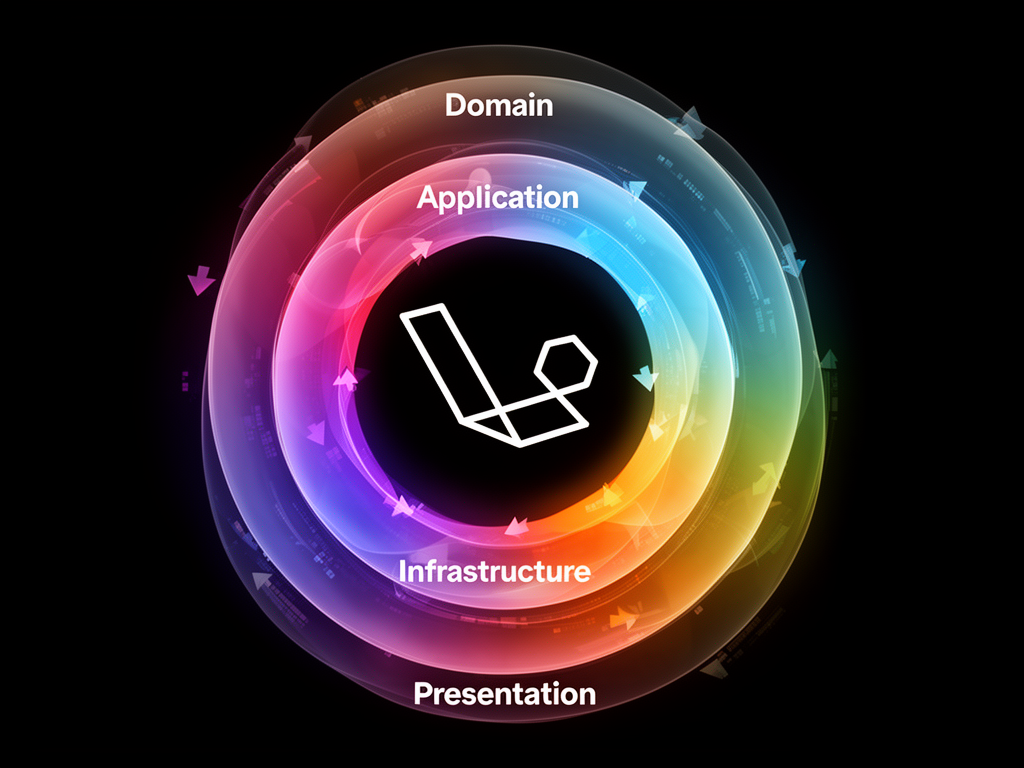
Clean architecture separates these concerns into layers:
The Domain Layer holds your core business logic—the rules that would be true even if you didn't have a database or a web framework. A booking entity knows what days are valid. A user knows when they're eligible for a discount. These are pure business concepts, independent of Laravel, Eloquent, or HTTP requests.
The Application Layer orchestrates actions. Use cases live here. A "create booking" use case takes user input, calls domain logic, asks repositories for data, and coordinates the side effects (emails, events). This layer says what should happen, not how.
The Infrastructure Layer handles the how. Database connections through Eloquent, external API calls, file storage, queue jobs. This layer is framework-specific and volatile—it's the first thing you'd need to rewrite if you switched databases or moved from Laravel to something else.
The Presentation Layer sits on top. Controllers, API resources, form requests. Thin, clean, focused on parsing input and formatting output. Controllers should parse a request, call one use case, and shape a response. Nothing else.
These aren't folders that look clean. They're actual boundaries where dependencies flow one direction only: inward. Your domain never imports your infrastructure. Your application never imports your presentation.
Why this matters when systems scale
Here's something that sounds like common sense but isn't always obvious: good architecture's job isn't to make simple things simpler. It's to make complex things possible.
When you're building a small CRUD app with a single developer, almost any structure works. You can get away with putting logic anywhere. But the moment your application accumulates real complexity—multiple teams, several years of business rules, integrations with external systems, changing requirements—your structure either saves you or sinks you.
Consider a booking system. At first, it's straightforward: users create bookings, bookings go in the database, users see their bookings. Simple enough to throw in a controller.
But then:
- You need to validate that time slots don't overlap.
- You add different booking types with different rules.
- You integrate with a payment processor.
- You add cancellation policies that vary by context.
- You build a mobile app that needs the same business logic.
- You want to switch from SQL to a different database.
- You need to add logging, auditing, and complex reporting.
Suddenly, that simple controller is handling database queries, payment logic, email sending, validation, and business rules all at once. To test a single piece of logic, you need to mock the database, the email service, and the payment processor. Making a change to how discounts work risks breaking the cancellation logic in three unexpected places.
With clean architecture, these concerns are separated. Your domain logic for validating bookings lives in one place and doesn't know about databases or payment processors. You can test it with a simple unit test and no mocks. Your application layer orchestrates the process—it knows the sequence of operations and calls the right use cases. Your infrastructure layer handles persistence, and if you need to switch from SQL to something else, you change one layer.
This doesn't make simple projects more complicated. It just means when your project becomes complicated, your code is already prepared.
The dependency rule: the guardrail that matters
There's one principle that holds everything together: the dependency rule. Source code dependencies must point inward.
In practical terms:
- Your domain layer doesn't depend on anything else.
- Your application layer depends on the domain but not the infrastructure.
- Your infrastructure depends on the application and domain.
- Your presentation depends on the application.
Why? Because dependencies represent coupling. When your business logic depends on your database choice, changing the database becomes risky—you're not just changing infrastructure, you're changing the core of your application. When your presentation depends on your business logic, adding a new UI means potentially rewriting your entire application layer.
By reversing this, you isolate the parts that change from the parts that need to stay stable. Your business rules—the expensive intellectual property of your company—stay isolated and protected. Your framework choice, database choice, presentation choice—these are implementation details you can swap out without touching your core logic.
This sounds theoretical. It isn't. It's the difference between a database migration that takes an afternoon and a database migration that takes a month.
Putting it into practice: a concrete example
Let's build something real. A simple blog system where users create posts. Nothing fancy. Just enough to see how the layers work together.
Domain layer: Here's where your Post entity lives. Not a database model. A pure object that knows what a Post is.
namespace App\Domain\Blog;

class Post {
    public function __construct(
        private string $title,
        private string $content,
        private \DateTime $createdAt
    ) {}

    public function isValid(): bool {
        return !empty($this->title) && strlen($this->title) >= 3;
    }

    public function getTitle(): string {
        return $this->title;
    }
}
This entity doesn't know about Eloquent. It doesn't know about databases. It's just business logic.
Application layer: Your use case lives here. This is what happens when a user creates a post.
namespace App\Application\Blog;

use App\Domain\Blog\Post;
use App\Domain\Blog\PostRepositoryInterface;

class CreatePostUseCase {
    public function __construct(
        private PostRepositoryInterface $repository
    ) {}

    public function execute(string $title, string $content): void {
        $post = new Post($title, $content, new \DateTime());

        if (!$post->isValid()) {
            throw new \InvalidArgumentException('Post title is too short');
        }

        $this->repository->save($post);
    }
}
Notice something important: this use case doesn't know how posts are saved. It depends on an interface, not a concrete implementation. That interface is defined in the domain layer.
Infrastructure layer: Here's where Eloquent lives. Here's how you actually persist to the database.
namespace App\Infrastructure\Blog;

use App\Domain\Blog\Post;
use App\Domain\Blog\PostRepositoryInterface;
use Illuminate\Database\Eloquent\Model;

class EloquentPostModel extends Model {
    protected $fillable = ['title', 'content'];
}

class EloquentPostRepository implements PostRepositoryInterface {
    public function save(Post $post): void {
        EloquentPostModel::create([
            'title' => $post->getTitle(),
            'content' => $post->getContent(),
        ]);
    }
}
This is the layer that can change. Want to switch to a different database? Change this layer. Want to use a different ORM? Change this layer. Your domain and application remain untouched.
Presentation layer: Your controller is beautifully simple.
namespace App\Presentation\Http\Controllers;

use App\Application\Blog\CreatePostUseCase;
use Illuminate\Http\Request;

class PostController {
    public function store(Request $request, CreatePostUseCase $useCase) {
        $validated = $request->validate([
            'title' => 'required|min:3',
            'content' => 'required',
        ]);

        $useCase->execute($validated['title'], $validated['content']);

        return response()->json(['message' => 'Post created']);
    }
}
The controller does one thing: it validates input, calls a use case, and formats a response. It doesn't know anything about your business logic. It doesn't know about databases. It doesn't know about the infrastructure.
Now test your business logic:
class CreatePostUseCaseTest {
    public function test_post_must_have_valid_title() {
        $repository = \Mockery::mock(PostRepositoryInterface::class);
        $useCase = new CreatePostUseCase($repository);

        $this->expectException(\InvalidArgumentException::class);
        $useCase->execute('ab', 'content');
    }
}
No database. No HTTP requests. No framework setup. Just pure business logic tested at lightning speed. This is why clean architecture matters.
Practical strategies that actually work
Clean architecture isn't about being perfect. It's about being intentional. Here are strategies that survive contact with real projects:
Keep contracts intentional. Don't create interfaces everywhere. Only create interfaces at true boundaries: persistence, external APIs, messaging systems. A private class that's unlikely to change doesn't need an interface. It's overhead without benefit.
Keep controllers policy-free. If a controller is making decisions about business logic ("if user is premium, do X, otherwise do Y"), your architecture is leaking. Business decisions belong in use cases or domain logic.
Make model mapping explicit. When you move data between layers, map explicitly. Don't pass database models into use cases. Don't pass use case objects into API responses. The conversion step is where you maintain control and prevent hidden coupling.
Put transaction scope in the application layer. If multiple operations need to succeed together or fail together, that orchestration belongs in use cases, not in domain entities.
Structure by bounded context when it makes sense. As your application grows, organize folders not by technical layer but by business domain: Sales, Billing, Identity. This reduces cross-team collisions and clarifies who owns what.
Migrate incrementally. You don't need to rewrite everything on day one. Start with new features using clean architecture. Gradually refactor critical paths. Big-bang rewrites rarely work in production systems.
When to use this, when to keep it simple
Here's the part that matters most: clean architecture isn't always the right answer.
Use clean architecture when:
- Your application will have a long lifespan and will accumulate business logic over time.
- Your business domain is non-trivial—the rules matter and will change.
- Multiple teams need to work in parallel without stepping on each other's toes.
- External dependencies are significant (APIs, databases, services that might change).
Keep it lighter when:
- You're building something short-lived (an MVP, a weekend project, a prototype).
- The logic is mostly straightforward CRUD operations.
- Your team is small and the scope is stable.
- You're optimizing for speed over everything else.
The goal isn't theoretical purity. The goal is matching your architecture to expected change. If your requirements are stable and simple, simpler patterns work fine. If your requirements will evolve and complexity will accumulate, clean architecture pays for itself quickly.
The real benefit
There's something I didn't mention until now because it's hard to measure but impossible to ignore.
When your architecture is clean, your codebase doesn't slowly drain your confidence. You don't wake up dreading changes because you don't know what will break. You can read the code and understand it because each piece has one clear purpose. New team members can onboard faster because the structure makes sense. Your tests are fast because they don't need the whole framework running. Your deployments are less stressful because you know changes are isolated.
This compounds over time. Six months in, you'll have built features faster than you would have in a poorly structured codebase. A year in, the difference is dramatic. Your velocity increases instead of decreasing. Your bugs decrease. Your team morale stays higher because the work is satisfying, not frustrating.
This is the real benefit of clean architecture. Not perfection. Not some pristine textbook structure. Just a codebase that remains workable and pleasant to live in as it grows. That's worth something. That's worth a lot, actually, if you've experienced the alternative.
The next time you're starting a Laravel project that might become complex, consider these principles. Not as dogma, but as a quiet framework—a structure that lets your application breathe as it inevitably grows beyond what you initially imagined. Because the code you write today isn't just for today. It's for the team that maintains it next year, when requirements have evolved and the system has accumulated real complexity. Structure that anticipates change isn't bureaucracy. It's kindness, extended across time, to everyone who comes after.