Contents
- 1 PHP Developer vs Full Stack Developer: Who to Hire
- 1.1 Understanding what each role really means
- 1.2 The specialist advantage: why PHP developers still win
- 1.3 The full stack reality: versatility with trade-offs
- 1.4 When you actually need a PHP developer
- 1.5 When you need a full stack developer
- 1.6 The money question
- 1.7 The decision framework
- 1.8 What great hiring actually looks like
- 1.9 The quiet truth
PHP Developer vs Full Stack Developer: Who to Hire
There's a moment that comes for every founder, every CTO, every project manager who's sitting down to figure out what kind of developer they actually need. You're looking at a budget, a timeline, a project that's growing in your mind like it's alive. And you have to make a choice: do you bring in a PHP specialist or a full stack developer?
It's not just a hiring decision. It's a philosophy choice about how your team will work, how your project will scale, and frankly, how much of the money in your account will still be there six months from now.
I've watched teams make both decisions. I've seen the ones that hired specialized PHP developers and shipped lean, efficient backends while frontend teams worked in parallel. I've also seen full stack developers come in and become the connective tissue that held chaotic projects together. Both paths work. But they work for different reasons, in different situations, with different costs attached.
Let me walk you through this with the clarity you actually need.
Understanding what each role really means
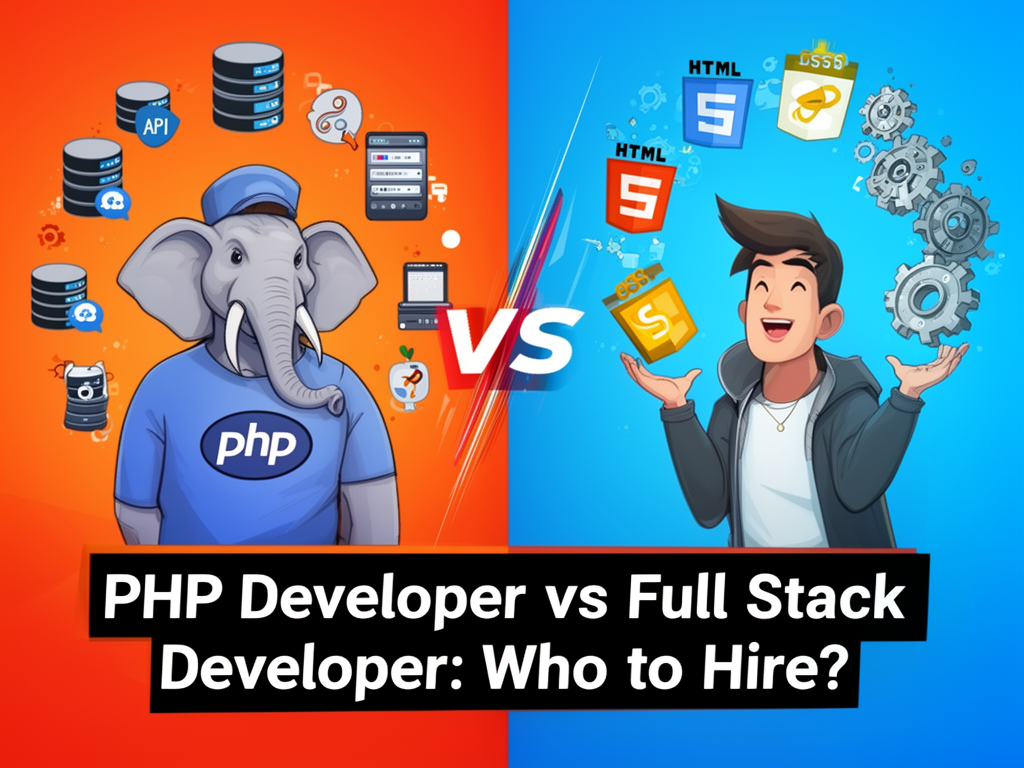
When you hire a PHP developer, you're bringing in someone who specializes in server-side architecture. They think in databases, APIs, and business logic. They understand how data flows through your system, how to secure it, how to make it perform under load. Their world is typically constrained to the backend — the engine room of your application.
The full stack developer lives differently. They move between worlds. Frontend, backend, sometimes infrastructure. They understand HTML, CSS, and JavaScript on the client side, and they can work with PHP, Python, Node.js, or other backend languages on the server side. They see the entire application as one organism, not separate components.
This distinction matters more than it sounds. It affects how they solve problems, how they communicate with your team, and crucially, how much you'll pay them.
The specialist advantage: why PHP developers still win
Here's something people often miss when they get caught up in full stack enthusiasm: deep expertise is irreplaceable.
A PHP developer who has spent years building e-commerce platforms, designing database schemas, and debugging production systems at 3 AM knows things that no generalist will ever know. They understand performance optimization at a level that feels almost intuitive. They've built payment systems, user authentication flows, API integrations that handle millions of requests.
When your project's primary challenge is backend functionality — complex server-side logic, payment processing, data management, API development — a specialized PHP developer will outperform a full stack developer almost every time. They can focus. They can go deep. There's no cognitive overhead switching between CSS frameworks and database indexing strategies.
This focus has a direct financial implication: PHP developers cost less. If you're a startup with a tight budget and you primarily need backend expertise, hiring a PHP specialist makes immediate sense. You're not paying for frontend capabilities you don't need. You're investing in the thing that will actually determine whether your application works.
And there's another advantage that gets overlooked: parallel work. If you have a solid frontend team already, a PHP developer slots in cleanly. Your frontend team builds the interface. Your backend team — or even a single PHP developer — builds the system that makes that interface meaningful. No coordination overhead. No waiting for someone to wear two hats.
The full stack reality: versatility with trade-offs
Full stack developers exist for a reason. Specifically, they exist for situations where you don't have the luxury of compartmentalization.
When you bring in a full stack developer, you're hiring someone who can own the entire development process from database design to user interface. This is powerful for certain scenarios. If you're a startup with a small team, a full stack developer becomes force multiplier. One person can iterate through the full stack, making decisions that keep the frontend and backend in sync.
For complex web applications like SPAs (Single Page Applications) or SaaS platforms, full stack developers reduce communication friction. They understand the constraints on both sides. When the frontend needs specific data structures, they already know how to deliver them. When the backend needs certain interface patterns, they can build them.
But — and this is important — this versatility comes with real costs. Full stack developers typically command higher fees because they can handle broader scope. And here's the painful truth that doesn't get discussed enough: being versatile often means being less specialized in each individual area. They may not have the deep expertise in database optimization that a dedicated backend specialist does. They may not have the refined eye for UI/UX that a frontend specialist has developed over years.
It's the classic trade-off. You get flexibility. You lose depth.
When you actually need a PHP developer
Let me be specific about the situations where hiring a PHP specialist makes sense:
- Your project is backend-heavy. API development, complex database design, custom workflows. The frontend is secondary or already handled.
- You need to optimize performance and security at the server level. A PHP developer who knows the language deeply will see issues that someone splitting their focus will miss.
- You have a strong frontend team already. You're filling a gap, not trying to be everything at once.
- Budget is a constraint. You need backend expertise without the full stack premium.
- You need someone to maintain and extend an existing PHP application. Deep knowledge of the codebase and the language matters.
- Custom CMS development, e-commerce functionality, or complex integrations. These are PHP's natural domain.
If you're building an API-driven application where the backend is genuinely complex, a PHP developer is the right hire. They'll design database schemas that scale. They'll write code that's maintainable and secure. They'll know frameworks like Laravel deeply enough to use them effectively.
There's also something quieter here: if you're someone who values craftsmanship in code, you want the specialist. A PHP developer with ten years of experience building systems isn't just writing code faster. They're writing code that works better.
When you need a full stack developer
Full stack developers become the right choice in different circumstances:
- You're building a complete application from scratch and your team is small. One person can move fast across the full stack.
- You have frontend and backend complexity, but not deep expertise in either yet. A full stack developer can establish patterns and practices on both sides.
- You're scaling a startup and you need flexibility. As your needs change, a full stack developer can shift focus without you needing to hire twice.
- Communication overhead is expensive. If your frontend and backend teams are far apart (geographically or organizationally), having someone who understands both reduces friction.
- Your project requires both extensive backend development and a polished user interface. Full stack developers excel at managing this integration.
There's also the reality of SaaS platforms and multi-functional web applications. If you're building something that integrates deeply across all layers — user interface, backend logic, database, infrastructure — a full stack developer provides that holistic view that keeps everything coherent.
But I want to be honest about this too: hiring a full stack developer because you're nervous about coordinating teams is solving the symptom, not the problem. Good communication between a backend specialist and a frontend specialist usually beats one person trying to do both, if the backend is genuinely complex.
The money question
Cost analysis is where hiring decisions actually get made, and it deserves straight talk.
A PHP developer is generally less expensive. You're hiring specialized knowledge. They do one thing, they do it well, their rates reflect that focus.
A full stack developer costs more upfront. But — and this matters — they potentially cost less overall if you're avoiding hiring multiple specialists. If you would otherwise hire a backend developer and a frontend developer separately, one full stack developer might be more cost-effective despite the higher hourly rate.
For large projects with ongoing complexity, where you truly need deep expertise on both sides, the full stack premium makes sense. The better integration, reduced coordination overhead, and faster iteration speed justify the higher cost.
But here's where it gets tricky: as projects grow in complexity, costs increase anyway due to additional features, redesigns, integrations. Planning your project scope clearly from the start, and hiring for the actual work you need to do — not the work you imagine you might need to do — keeps costs reasonable.
Small project, well-defined backend requirements? Hire the PHP specialist. You'll save money and get better results.
Large project, multiple layers, small team? Full stack developer. You'll pay more, but you'll move faster and avoid communication overhead.
The decision framework
Here's what I actually think you should do when you're sitting down to make this hiring decision:
First, be honest about your project scope. Not the scope you hope for. The scope you actually have right now. Is it primarily backend work? Is your frontend already handled? Can you describe your technical challenges in terms of server-side logic, database design, APIs? If yes to all of these, hire a PHP developer.
Second, assess your team. Do you have strong frontend developers already? Do you have people who can collaborate effectively across specialties? If your team is cohesive and has gaps you can fill, a PHP specialist plugs in cleanly. If your team is small and everything feels like it needs generalists, full stack makes more sense.
Third, look at your budget and timeline honestly. PHP developers are more affordable. Full stack developers move faster across the full project. There's a real trade-off here that depends on your constraints.
Fourth, think about your long-term vision. If you expect ongoing scaling, updates, and expansion, full stack developers adapt better to changing needs. If you're optimizing a stable backend and focusing on performance and security, a PHP specialist is your person.
And finally, consider the actual work you need done. If you need someone to build custom dashboards, implement advanced user roles, integrate APIs, or design subscription systems — the classic backend-heavy work — a PHP developer who knows Laravel or similar frameworks will deliver faster and cheaper than waiting for a full stack developer to finish other tasks.
What great hiring actually looks like
The best hire isn't always the most versatile person. It's the person who matches your actual needs with genuine expertise.
I know developers who specialize in PHP and can architect systems that handle massive scale. I know full stack developers who can move seamlessly across the entire stack and deliver polish on every layer. Neither is inherently better. They're right for different situations.
When you're hiring, look for someone whose experience matches what you're actually building. If you're hiring a PHP developer, look for evidence of deep backend work — complex systems they've built, performance optimizations they've made, security considerations they understand. Don't hire them hoping they'll grow into full stack. Hire them because you need what they do.
If you're hiring full stack, look for evidence of real depth on multiple layers. Not dabbling. Actually building significant features on both sides. Someone who understands the constraints of each layer and how to work between them effectively.
Skills matter, but judgment matters more. The best developers in any role are adaptable, curious, and willing to learn new tools. They also know what they don't know and aren't afraid to say so.
The quiet truth
There's something nobody really talks about when comparing these roles: the difference is increasingly about organizational scale, not ability.
A very talented PHP developer could probably learn enough frontend skills to ship full stack work. A very talented full stack developer could probably go deeper into backend systems if they focused. But in practice, people specialize because specialization works. It lets you get really, really good at something.
The question you're asking isn't just "which role do I hire?" It's "what are we actually building and what do we need right now?"
Build a backend-heavy system and you need someone with PHP expertise running deep. Build a full application in a small team and you need someone who can think across the whole stack. Neither choice is wrong. They're just right for different things.
The developers you find through find-php.com — whether they're specialists or full stack — will tell you what they're strong at if you ask directly. Listen to them. Hire for the work you actually have, not the work you imagine you'll have. And remember that the best hiring decision is the one made with clarity about what your project truly needs, not what sounds impressive.
Because in the end, it's not about the title. It's about someone who knows their craft deeply enough to see the right solution, then builds it with care.