Contents
- 1 Php developer vs JavaScript developer: the quiet fork in the road
- 2 What a PHP developer really does all day
- 3 What a JavaScript developer really does all day
- 4 Learning curve: how each path feels in your hands
- 5 Career paths: what your future weeks might look like
- 6 Job market and salaries: boring but important
- 7 Work style: what kind of problems do you want to wake up to?
- 8 Switching paths: PHP to JS, JS to PHP
- 9 How to choose if you’re just starting out
- 10 The quiet advantage of each path
- 11 A note on identity (and impostor syndrome)
- 12 If I had to give you one piece of advice
Php developer vs JavaScript developer: the quiet fork in the road
There’s a moment most web developers remember.
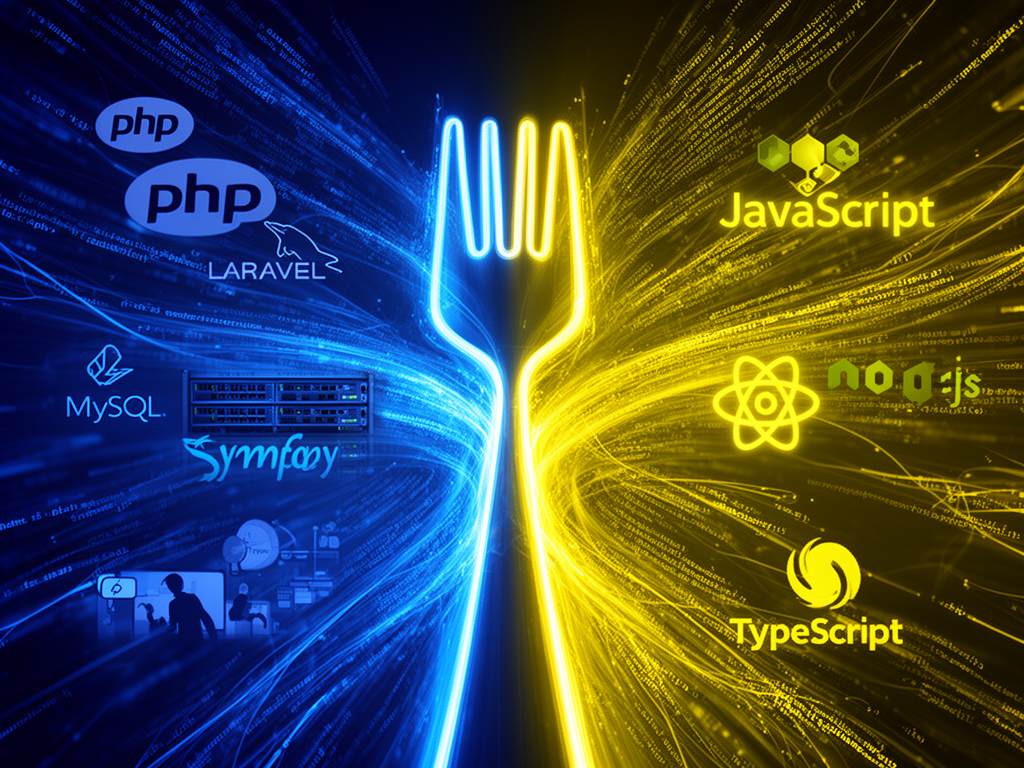
It’s late. The office (or your kitchen) is quiet. You’re staring at a job board with two tabs open:
- “PHP Developer (Laravel, Symfony, SQL…)”
- “JavaScript Developer (React, Node.js, TypeScript…)”
Same you. Same keyboard. Two very different futures.
If you’re standing at that fork right now, this is for you.
Not a language war. Not “which is better.”
More like: who do you want to become — as a professional, as a teammate, as a person who ships things on the web.
Let’s walk through it like colleagues on a long evening video call, coffee in hand, VS Code still open in the background.
What a PHP developer really does all day
Strip away the memes and outdated jokes and you get something simple.
A PHP developer is usually the person who makes sure the money, data, permissions, and business rules of an application… actually work.
On a typical week, that might look like:
- digging into a Laravel or Symfony codebase to adjust a pricing rule;
- wiring a new feature into an existing MySQL/PostgreSQL schema;
- fixing that one report the CFO swears “was working last quarter”;
- extending a WordPress or Magento plugin for a marketing campaign;
- reviewing PRs that touch authentication, billing, or background jobs.
PHP lives on the server. It renders HTML, serves JSON, hits databases, talks to payment gateways, and executes the business logic nobody remembers until it breaks.
When someone logs in, checks an order, resets a password, or pulls a CSV with last month’s revenue, there’s a decent chance a PHP script somewhere is quietly doing the heavy lifting.
Where PHP work usually happens
A lot of PHP jobs sit inside:
- product companies with a long-lived monolith (often Laravel, Symfony, or a homegrown framework),
- agencies building content-heavy or e‑commerce sites,
- businesses whose public site or intranet is powered by WordPress, Drupal, or Magento,
- SaaS tools built back when “LAMP stack” was printed proudly on job ads, and that now quietly print money.
The pattern is familiar:
- stable revenue,
- long-lived codebases,
- real-world constraints,
- and a lot of “if we break this, the sales team will call in five minutes.”
It’s less hype-driven, more responsibility-driven.
What a JavaScript developer really does all day
A JavaScript developer spends most of their attention on what the user touches.
The buttons. The flows. The parts that feel “alive.”
On the front end, that usually means:
- wiring React/Vue/Angular components to APIs,
- optimizing load times and bundle sizes,
- obsessing over a modal that still janks on slow phones,
- debugging some cursed event listener that only fails in Safari.
On the back end, with Node.js, it can look like:
- building REST/GraphQL APIs,
- wiring WebSockets for chats/notifications,
- processing events and queues,
- gluing microservices together.
JavaScript runs in the browser and (with Node.js) on the server, which means many JavaScript roles are either front-end focused or full‑stack flavored.
Because JavaScript is built around asynchronous, event-driven behavior, it tends to shine on things like:
- live dashboards,
- collaborative tools,
- real-time chats,
- streaming and event-driven pipelines.
Where JavaScript work usually happens
You’ll see strong JavaScript demand in:
- product teams building SPAs or mobile-first apps,
- startups shipping new features fast,
- SaaS platforms where UX is a core value prop,
- companies going “all-in TypeScript/Node.js” for new services.
The work leans toward the visible: interactions, flows, real-time behavior, fast feedback loops. You often sit closer to design and product.
If PHP is often where the rules live, JavaScript is often where the experience lives.
Learning curve: how each path feels in your hands
Ignore the theory for a second. Let’s talk about the learning feel.
How PHP feels to learn
PHP is famously forgiving.
You can:
- drop a
.phpfile on a server, - write
<?php echo "Hello"; ?>, - refresh the page… and it works.
The core model is straightforward:
Request in → code runs top-to-bottom → HTML/JSON out.
Most people find PHP’s basic syntax and flow relatively beginner-friendly.
Once you step into frameworks like Laravel or Symfony, the structure and patterns grow more sophisticated, but the mental model stays mostly linear. That can be a relief when you’re starting out.
How JavaScript feels to learn
On the surface, JavaScript is easy: drop <script> in a page and log to the console.
Then you hit:
- the DOM,
- events,
- callbacks, promises, async/await,
- the difference between
nullandundefined, - “this” behaving like it has a personal vendetta.
Modern JavaScript is powerful but carries a steeper cognitive load, especially once you factor in tooling (bundlers, linters, TypeScript, frameworks).
On the other hand, once you internalize its asynchronous, event-driven nature, a lot of advanced patterns open up — and that’s intoxicating in the best way.
Emotional reality of the learning curve
- With PHP, many people hit productivity earlier. You see working features sooner. Confidence builds from shipped code.
- With JavaScript, you might feel lost longer — but when it finally clicks, you suddenly understand both client-side behavior and have a path into back-end work via Node.
So if your nervous system prefers clarity and linearity, PHP often feels like home.
If you like juggling multiple things in your head, wiring events and flows, JavaScript scratches a different itch.
Career paths: what your future weeks might look like
Imagine yourself 3–5 years in. Same person, two timelines.
Timeline A: the PHP developer
You probably:
- own large, business-critical chunks of a back-end system,
- live inside a framework (Laravel, Symfony, maybe legacy code),
- care about database design, caching layers, and performance,
- understand the business domain deeply: pricing, billing, permissions.
You might grow into:
- senior PHP developer or lead backend engineer,
- technical lead on a long-lived product,
- architect for a monolith or modular backend,
- or a full‑stack PHP dev, with enough JavaScript to build solid UIs.
Much of your value is in your ability to:
- reason about complex logic,
- handle migrations without downtime,
- keep systems maintainable over years,
- and calmly take responsibility when production misbehaves at 3 AM.
Timeline B: the JavaScript developer
You probably:
- are deeply fluent in at least one front-end framework,
- understand browser performance and UX flows,
- or know Node.js/TypeScript well enough to build APIs and services.
You might grow into:
- front-end lead or UI engineer,
- full‑stack JS developer (React + Node.js),
- staff engineer shaping front-end architecture across teams,
- or a developer experience / tooling engineer improving builds, design systems, and pipelines.
Your value tends to cluster around:
- user-facing features,
- design collaboration,
- performance and accessibility,
- and tying together many small services and APIs.
Job market and salaries: boring but important
You’ll find opinions everywhere, but let’s ground it in reality.
Demand for PHP vs JavaScript
Search interest in PHP vs JavaScript jobs tends to rise and fall in similar patterns over time, without a clear, dramatic long-term winner.
Why?
Because:
- PHP still powers a huge portion of the web (WordPress, legacy systems, mature SaaS).
- JavaScript is everywhere on the front end and increasingly common on back-end stacks.
In practice:
- You’ll see PHP-heavy roles in agencies, e‑commerce, CMS-driven projects, and established products.
- You’ll see JavaScript-heavy roles in startups, SPAs, real-time apps, and internal tools.
Both stacks remain employable and relevant.
Salary snapshots (PHP side)
Recent research and job portals put PHP developer salaries in the US roughly in the:
- ~$72k–$106k+ per year band on average, depending on source, role, region, and experience.
Mid/senior PHP developers, especially those who can handle architecture and performance, tend to be well-compensated — particularly in markets like the US and Western Europe.
JavaScript/Node.js roles often report similar or slightly higher averages in some markets, especially in product‑driven tech hubs — but the exact numbers swing a lot by city, seniority, and whether you land in product vs agency vs enterprise.
The more interesting takeaway:
- Both paths can support a very comfortable life.
- Both can lead to high-salary senior and lead roles.
- Your ability to deliver and collaborate will matter more, in the long run, than the language on your business card.
Work style: what kind of problems do you want to wake up to?
This is where the decision gets personal.
If you lean toward PHP, you might enjoy:
- understanding how money, data, and rules move through a system,
- untangling complex legacy logic and making it saner,
- thinking in terms of transactions, invariants, and consistency,
- slowly improving a large codebase that runs something real and important.
Your workday might be:
- code reviews around architecture and data flows,
- conversations with product or ops about edge cases,
- careful rollouts, migrations, and performance tuning.
If you lean toward JavaScript, you might enjoy:
- seeing your work instantly in the browser,
- pairing with designers to nail an interaction,
- tuning performance so the app “feels” fast,
- jumping between front-end and back-end tasks in a full‑stack setup.
Your workday might be:
- iterating on UX flows,
- tweaking responsiveness and accessibility,
- managing complex component trees and state,
- integrating multiple APIs into a cohesive front-end experience.
Neither is “more real” than the other. They’re just different ways of caring about the web.
And underneath both, the same principles matter:
- clean abstractions,
- readable code,
- tests that let you sleep at night,
- kindness in code review.
That’s the stuff that quietly determines how far you’ll go.
Switching paths: PHP to JS, JS to PHP
Here’s a secret many juniors don’t hear enough:
You’re not marrying a language. You’re starting with one.
From PHP to JavaScript
This is incredibly common.
If you start with PHP, you’re almost guaranteed to write JavaScript anyway: for forms, small interactions, maybe Vue/React embedded in a Laravel app.
Over time, many PHP developers:
- get fluent on the front end,
- pick up Node.js for scripts or services,
- end up effectively full‑stack, with PHP as their “native tongue.”
On a platform like Find PHP, this kind of profile is gold: someone who can own the backend and talk to the front-end folks without a translator.
From JavaScript to PHP
Less talked about, but it happens.
Maybe you’re a React developer who:
- wants to move closer to where the business rules live,
- is tired of five competing front-end meta-frameworks,
- or discovers that a big, solid monolith is… kind of nice.
With strong JS fundamentals, picking up PHP and a modern framework like Laravel is very doable. The hardest part is less the syntax, more the shift in thinking toward database design, domain modeling, and server-side architecture.
Either way, once you’ve gone deep with one language, the second is never as scary.
How to choose if you’re just starting out
Forget trends for a moment. Ask yourself a few blunt questions.
Question 1: What makes you lose track of time?
Think about the last time you were coding and forgot to eat.
Were you:
- wiring backend routes, database queries, and domain logic?
- or tweaking a UI until it felt just right, playing with animations, layouts, and flows?
If the guts of the system fascinate you — go PHP-first (and add JavaScript as needed).
If the experience in the browser excites you — go JavaScript-first (and add back-end skills over time).
Question 2: What kind of teams do you imagine yourself in?
- A product team shepherding a long-lived system with a big PHP backend and a mix of front-end tech?
- A hybrid team building a crisp JavaScript front end over APIs, rewriting pieces as services in Node?
Both exist. Both hire. Both ship.
Picture the day-to-day you want more than the tech stack you want to brag about.
Question 3: What does your local market look like?
Open a job board for your country or city.
- Count PHP roles.
- Count JavaScript roles (front-end + Node.js + “full-stack JS”).
Look at:
- which industries they’re in,
- what salary ranges appear,
- which ones feel like places you’d want to work.
PHP has deep roots in many local markets — agencies, e‑commerce, internal tools. JavaScript-heavy roles often cluster around newer product companies and startups.
On Find PHP, this is very visible: a lot of solid, serious PHP roles where companies want someone reliable to own critical back-end systems.
Use that as a mirror, not a verdict.
The quiet advantage of each path
Every language has a kind of “hidden superpower” in a career.
PHP’s quiet advantage
PHP’s superpower is stability with depth.
- It powers a huge, boring (in the best sense) chunk of the web.
- It lives where revenue, permissions, and data risk are highest.
- The codebases are often older, but that means they’re battle-tested.
If you enjoy becoming the person who understands those systems deeply, your career can compound quietly and steadily. You become hard to replace, not because you hoard information, but because you think in terms of resilience and business continuity.
JavaScript’s quiet advantage
JavaScript’s superpower is reach.
- The browser.
- The server (Node.js).
- Desktop (Electron), mobile (React Native, etc.), scripting, tooling.
If you enjoy being able to jump between layers and environments, JavaScript lets you touch almost every part of the modern stack.
You become the person who can trace a bug:
- from a misfiring event handler in the browser,
- through an API call,
- into a Node.js service,
- and back out through a WebSocket update.
Different flavor of irreplaceable. Equally valuable.
A note on identity (and impostor syndrome)
Here’s something that doesn’t get said enough on comparison posts:
You are not your stack.
You will change.
You might:
- start as a PHP developer integrating payment gateways,
- learn enough JavaScript to own a front-end rewrite,
- move into technical leadership where you care less about syntax and more about people and trade-offs.
Or:
- begin as a front-end JavaScript dev obsessing over CSS grids,
- pick up Node.js, then a bit of PHP to work with a legacy system,
- end up as an architect whose job is mostly conversations and diagrams.
The stack is just the lens through which you learn to see systems.
And when you’re up late, debugging some inscrutable race condition or tracking down why a query suddenly exploded in production, the thing that keeps you going won’t be “am I a PHP or JavaScript developer?”
It’ll be: There’s a problem. People are waiting. I know how to think about this.
If I had to give you one piece of advice
Pick the path that makes you want to sit down tomorrow and write code you’re genuinely curious about.
- If that’s building a robust API in PHP, tuning queries, and nailing domain logic — lean into it.
- If that’s crafting an interface in JavaScript that feels delightful to use — lean into that.
You can always cross over later. You can always become full‑stack. You can always relearn.
The web is full of people who started somewhere, changed direction, and quietly built a life around code.
Some of them are PHP developers listed on Find PHP. Some are JavaScript folks, noses buried in their React components. Some are both and no longer feel the need to draw hard lines.
The important part is that you start, keep going, and let your work slowly turn into something you’re proud to put your name on, even if nobody notices the language that carried it there.