Contents
PHP vs Laravel: What Is the Difference
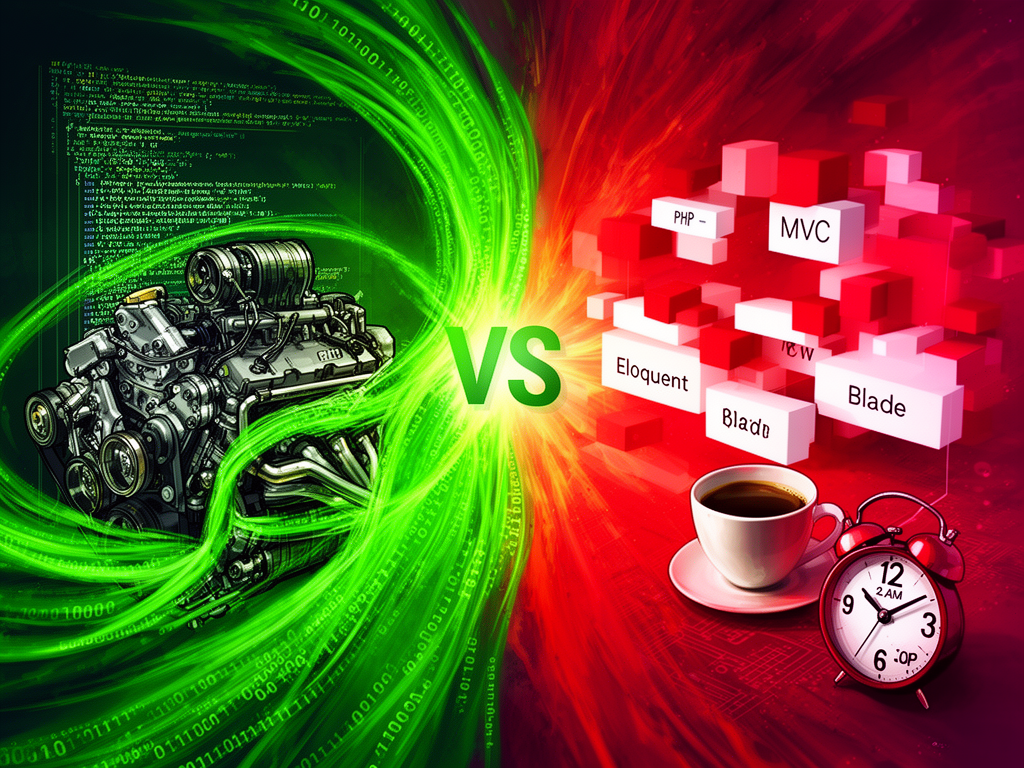
Hey, fellow developers. Picture this: it's 2 AM, your coffee's gone cold, and that deadline's breathing down your neck. You're staring at a blank screen, deciding between raw PHP—pure, unfiltered power—or Laravel, the framework that promises to handle the grunt work. I've been there, more times than I care to count. PHP is the language we all started with, the one that powers half the web. Laravel? It's PHP dressed up for the big leagues, with tools that make complex apps feel almost… easy.
But what's the real difference? PHP is the core scripting language for dynamic web pages. Laravel is a full-fledged framework built on PHP, enforcing structure to speed up development and cut maintenance headaches. One's a toolbox; the other's a pre-assembled workshop. Let's break it down, no fluff—just the truths I've learned from late-night debugging sessions and projects that shipped (or didn't).
The Raw Power of Core PHP
Core PHP feels like driving a manual sports car. You control everything. No frameworks dictating your moves. It's modular, flexible, and lightning-fast when you write clean code.
-
Speed that hits hard: Benchmarks show PHP processing 1617 instructions simultaneously, handling 9000 commands per second, and rendering 90,000 lines of code in a minute. Raw PHP embeds directly into HTML, executes scripts blazingly fast, and reuses code across projects without overhead.
-
Ultimate flexibility: Want to bend rules? Core PHP lets you. No strict architecture—just build what you need. It's perfect for custom tweaks, small scripts, or when you need to squeeze every drop of performance. I've prototyped MVPs in hours this way, no bloat.
But here's the rub: everything's manual. Routing? You code it. Caching? Third-party or bust. Security? On you. Error handling? Same deal. It shines for simple sites or when you crave control, but scale up, and chaos creeps in. Code gets messy, teams struggle to onboard, and bugs hide in the shadows.
Have you ever inherited a "flexible" PHP project? The kind where functions are scattered like confetti? Yeah. That's the double-edged sword.
Laravel: Structure Meets Sanity
Now, Laravel. It's PHP with guardrails—MVC architecture, built-in everything, and an ecosystem that feels alive. Think of it as PHP's thoughtful older brother who plans ahead.
-
MVC magic: Models, Views, Controllers. Laravel enforces this, organizing code neatly. Huge datasets? No sweat. It simplifies workflows, boosts SEO with clean structures, and scales for enterprise apps.
-
Tools that save your soul:
- Eloquent ORM: Database interactions feel poetic. No raw SQL nightmares—just expressive syntax for models and relationships.
- Blade Templating: Ditch plain PHP echoes. Blade handles conditionals, loops, and master layouts effortlessly. Save views as .blade.php, extend them like Lego.
- Routing, caching, auth: All inbuilt. Security tokens, exception handling, PHPUnit testing—Laravel bundles them. Caching backends minimize response times with pre-stored data.
- Artisan commands: Generate scaffolding in seconds. Queues with Horizon, APIs with Passport. Deployment? Forge or Vapor.
Performance? Laravel's layered setup is slower than raw PHP—fewer instructions per second—but its caching and optimizations close the gap for real apps. Plus, debugging tools catch errors early. Community? Massive. Packages galore, tutorials everywhere. Onboard a junior dev? They ramp up fast.
I've built SaaS platforms in Laravel that teams of five maintain effortlessly. Raw PHP? Solo heroics only.
Head-to-Head: The Comparison Table
Let's get visual. Here's how they stack up, pulled from real benchmarks and my battle-tested experience:
| Aspect | Core PHP | Laravel |
|---|---|---|
| Architecture | Modular, flexible | MVC, structured |
| Performance | Faster raw speed (9000 cmds/sec) | Slightly slower, but optimized caching |
| Flexibility | Total control, no rules | Some conventions, but extensible |
| Development Speed | Quick for small stuff | Faster overall with reusability |
| Learning Curve | Steep for complex apps | Beginner-friendly, intuitive |
| Security/Features | Manual everything | Built-in auth, ORM, testing |
| Ecosystem | Limited | Huge (Forge, Nova, Horizon) |
| Best For | Prototypes, custom microsites | Scalable apps, teams, SaaS |
Core PHP wins on raw speed and freedom. Laravel dominates maintainability, scalability, and team workflows.
When to Pick PHP, When Laravel Feels Right
Ease of development? Laravel edges out with object-oriented libraries and reusability. Core PHP's faster for tiny scripts, but Laravel's scaffolding crushes boilerplate—think contact forms in 50 lines vs. 200+. Security? Laravel's got CSRF protection, auth out-of-the-box. PHP? You build it, pray it holds.
Scalability tells the tale. Raw PHP handles high-performance niches, but Laravel's queues, events, and service containers thrive in enterprise builds. Remember that project where unstructured code turned into a monster? MVC prevents that. Laravel's for evolving codebases—SaaS, APIs, dynamic apps.
Real talk: small freelance gig, tight budget? Core PHP. Team project, long-term maintenance? Laravel, hands down. I've seen PHP sites crumble under growth; Laravel apps just… keep going.
What about trade-offs? Laravel introduces dependencies—external packages can bite if outdated. PHP? Pure, stable, no surprises. And learning: PHP's basics are simple, but mastery takes grit. Laravel? Dive in, conventions guide you.
Lessons from the Trenches
Last year, I refactored a legacy PHP monolith into Laravel. Weeks of pain became days of polish. Eloquent slashed query time; Blade made views breathe. But stripping away PHP's flexibility? It forced better habits.
Friends, don't romanticize raw PHP's speed—it's a trap for solo warriors. Laravel isn't "less PHP"; it's PHP evolved. It enforces best practices so you focus on what matters: shipping code that lasts.
In the end, the web hums on both. Choose based on your war stories. Grab a fresh coffee, fire up your IDE, and build something that outlives the deadline. Your next project might just thank you for it.