Contents
- 1 PHP vs Python: What to Learn First
- 1.1 Understanding the two paths
- 1.2 The speed question: getting to your first win
- 1.3 The learning curve: where does it get hard?
- 1.4 Performance: does it matter right now?
- 1.5 The job market reality
- 1.6 The ecosystem: where do you want to spend your days?
- 1.7 The honest truth about "first language"
- 1.8 Where this might lead you
- 1.9 The decision
PHP vs Python: What to Learn First
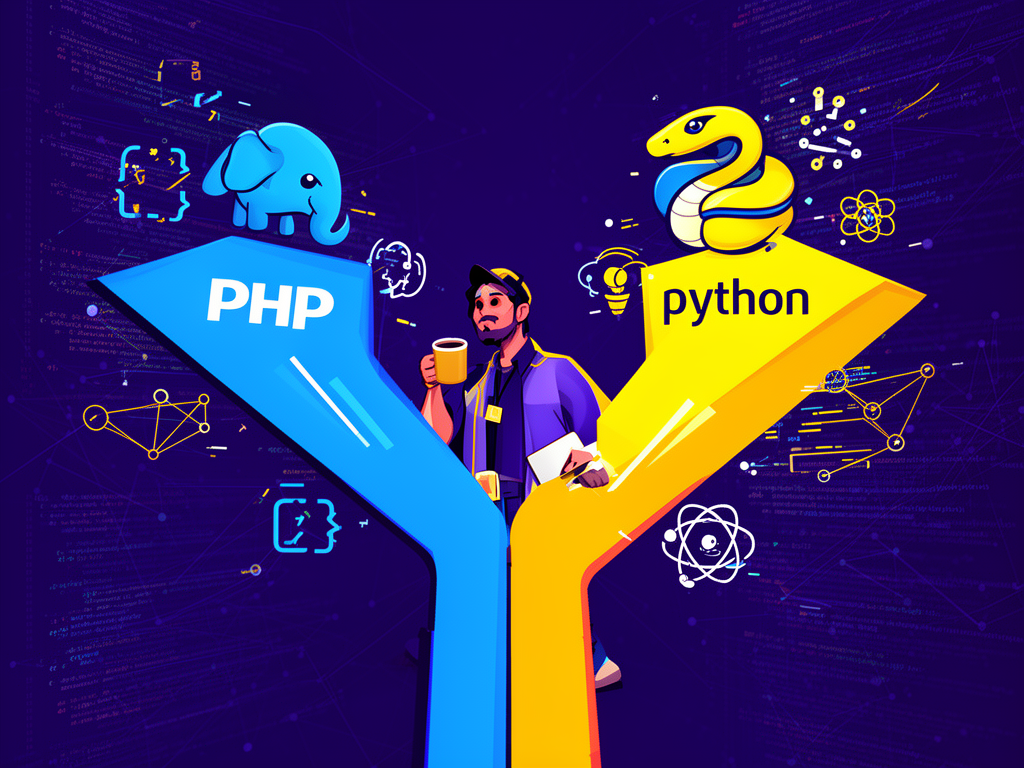
There's a question that sits at coffee tables, in Discord servers, and in the quiet moments before you decide to commit to learning something new. You're standing at the crossroads—do you go left toward PHP, or right toward Python?
I remember that feeling. A few years back, I was exactly where you might be now. Two languages, both promising, both in demand, both with different flavors of possibility. The question isn't really which one is objectively "better." That's a trap. The real question is: which one matches where you want to go, and which one won't make you resent the early mornings you'll spend learning it?
Let's talk about this honestly.
Understanding the two paths
PHP and Python represent two fundamentally different philosophies about web development. They've been around long enough to prove themselves, yet they've evolved enough that comparing them today looks different from comparing them a decade ago.
PHP is the old friend who specializes in one thing and does it exceptionally well. It was built for the web from the beginning. Every decision made when creating PHP had web development in mind. You want to serve dynamic web pages, handle form submissions, work with databases? PHP was born for this. Over seventy percent of all websites with a known server-side programming language run on PHP. That's not a coincidence. That's dominance through focus and reliability.
Python, on the other hand, is the versatile friend who was never meant for web development but fell into it and became brilliant at it anyway. Python wasn't designed as a web language. It grew up as a general-purpose tool. Data science, artificial intelligence, automation, backend services—Python touches all of it with equal grace. When you choose Python for web development, you're choosing a language that can also be your data processing engine, your machine learning framework, your automation script, all in the same codebase.
These aren't just technical differences. They represent different futures for your career.
The speed question: getting to your first win
Here's what matters when you're just starting: you want to feel progress. You want that moment when something you built actually works. It sounds small, but it shapes everything about your motivation to keep going.
PHP wins this round, and it wins decisively. Because it was designed specifically for web development, the entire ecosystem is optimized for speed to market. WordPress, Joomla, Laravel—these are battle-tested frameworks that let you build and deploy websites without reinventing the wheel every single time. A beginner can have a functional website running within days, not weeks. Your first success comes faster.
Python frameworks like Django and Flask are also fast, but they come with more conceptual overhead. You're not just learning web development; you're learning Python's philosophy first. You need to understand more about how the language itself works before you can effectively use these frameworks. The speed advantage exists, but it's softer, less immediately satisfying.
This matters psychologically. Your brain needs wins. Especially when you're new.
The learning curve: where does it get hard?
Both languages are praised for being relatively easy to learn compared to C++ or Java. But "easy" is relative, and the difficulty curves differently.
Python is often considered simpler from a syntax perspective. Its code reads almost like English. You can show Python code to someone who doesn't know programming, and they can often understand what it does. This is real. Python's readability is genuine. For pure language learning, Python gets you faster to "I can understand code."
But here's the catch nobody talks about as much: simplicity of syntax doesn't mean simplicity of mastery. Python's frameworks are more complex than they initially appear. Django has opinions about how you should structure your entire application. The "batteries included" approach means learning Django means learning Django's way of thinking. For some people, this is liberating. For others, it feels constricting when you don't yet understand why those batteries are arranged the way they are.
PHP has a gentler conceptual curve for the basics. You're mostly thinking about files, requests, and responses. The learning experience feels more linear. Here's the fundamental concept, here's how to apply it, here's your working website. The progression feels more natural for beginners because it mirrors the simplicity of web requests themselves—someone asks for a page, you send them a page. That's PHP at its core.
Performance: does it matter right now?
There's a common narrative that PHP is faster than Python. The numbers support this somewhat—PHP 7 and PHP 8 have been optimized to handle traditional web requests very efficiently. When you're serving standard web pages with database queries, PHP performs exceptionally well, often without requiring complex optimization work.
Python is slower at the raw execution level because it's an interpreted language, not compiled like PHP. But frameworks like FastAPI, which saw dramatic adoption increases in 2025, can actually rival PHP in many real-world scenarios through asynchronous architecture.
Here's my honest take: if you're just starting, performance differences don't matter yet. Your first ten projects won't have performance problems because they'll have tiny traffic. You'll learn the language, build something small, and move on to the next thing. Performance matters after you've built something that matters. By then, you'll understand your chosen language well enough to optimize it if needed.
Don't choose your first language based on performance. That's like choosing your first car based on fuel economy when you haven't learned to drive yet.
The job market reality
Let me give you the numbers straight up, because this matters when you're investing your time.
Python is the most sought-after programming language right now. With 45.7% of recruiters actively looking to hire Python developers, there are more than 64,000 open vacancies for Python roles in the US alone. The median salary for a Python developer hovers around $90,000, though senior developers command significantly more. Python's growth isn't slowing. It's the language of data science, machine learning, and increasingly, modern backend development.
PHP is less glamorous in the current market conversation, but the numbers tell a different story than the hype suggests. There are more than 22,000 PHP developer jobs listed globally on LinkedIn. A PHP developer can expect around $92,696 in median salary, comparable to Python. The difference? PHP jobs feel stable and consistent rather than explosive. Companies maintain PHP applications because they need those applications to keep running. The work is steady.
This is important context for your choice. Python feels like the growing market. PHP feels like the established market. Both offer genuine opportunity.
The ecosystem: where do you want to spend your days?
PHP's ecosystem is entirely focused on one thing: making websites and web applications work. Content management systems, eCommerce platforms, payment integrations—this is where PHP shines. If your dream is to build web applications, PHP's ecosystem is incredibly mature and battle-tested. You'll rarely find yourself thinking, "How do I do X with PHP?" The answer already exists, refined through thousands of production websites.
Python's ecosystem stretches far beyond web development. Machine learning libraries like TensorFlow and PyTorch, data science tools like Pandas and NumPy, automation frameworks—if you want to build something that touches AI, data processing, or advanced backend systems, Python's ecosystem is incomparably rich. But this breadth can feel overwhelming if web development is all you want to do.
This is the key differentiator that often decides things. What does your brain want to think about every day?
If your answer is "I want to build web applications, full stop," PHP might actually be your faster path to competence and confidence. The language is direct, the frameworks are straightforward, the ecosystem is purpose-built for web development. You could be building real, production-level websites within months. The job market for PHP is stable and real, even if it doesn't generate the excitement that Python does. You'd be joining millions of developers maintaining and improving some of the web's most critical infrastructure.
If your answer is "I want to understand how modern systems work, I want to potentially explore data science or machine learning, I want a language that grows with me beyond just web development," Python is the choice. The initial learning curve is gentler in many ways. The job market is more explosive. The ecosystem is richer and broader. The salary trajectory might be higher. But you'll need to be patient with the complexity that emerges after the basics are comfortable.
The honest truth about "first language"
Here's what they don't tell you: your first language doesn't matter as much as you think it does. What matters is that you choose one and commit to it. Learning programming is hard. Not because the concepts are difficult—they're not—but because consistency is difficult. You need to show up on difficult days, debug frustrating problems, and resist the urge to quit when your code doesn't work for the fifth time in a row.
The best first language is the one that keeps you interested enough to push through those moments. If you're genuinely excited about machine learning and data science, choose Python, even if PHP would technically get you to "first working website" faster. Your excitement will sustain you through the harder parts.
If you're fascinated by how the web itself works, how requests become responses, how databases power real websites that millions of people use—choose PHP. Your curiosity will fuel your learning.
There's also this: once you've genuinely mastered one language, learning a second becomes exponentially easier. Programming languages are more similar than they are different. The concepts that matter—functions, loops, variables, objects, error handling—exist in both. You're not really choosing a lifelong commitment; you're choosing where to start. And starting somewhere, anywhere, with genuine intention, is better than staying frozen at the crossroads.
Where this might lead you
One more consideration: where might each path lead over five or ten years?
The PHP path leads you deeper into web development. You might specialize in Laravel, becoming a master of modern PHP frameworks. You might become the person companies call when they need to scale their WordPress installation to handle ten million monthly visitors. You might move into DevOps or system administration, leveraging your deep web infrastructure knowledge. The career progression is real, stable, and financially rewarding.
The Python path is less linear but potentially broader. You start with web development, but you have options. As you grow, you can pivot toward backend infrastructure, data engineering, machine learning, scientific computing. Python lets you stay versatile in ways that pure web development languages don't. Some of the highest-paid engineers in the world started with Python and used it to explore multiple specializations.
The decision
So what should you learn first?
If you're motivated primarily by building web applications quickly and joining a massive, stable community of developers maintaining critical infrastructure, learn PHP. You'll feel productive faster. You'll contribute to real projects sooner. The ecosystem is mature, reliable, and purpose-built for exactly what you're trying to do.
If you're intellectually curious about how data flows through systems, if you think you might want to explore machine learning or data science, if you want a language that grows with you beyond just web development, learn Python. The initial investment is slightly higher, but the returns compound over time. You're not just learning a web language; you're learning one of the most important languages in computer science.
But understand this: both choices are legitimate. Both languages will give you a sustainable career. Both have active communities. Both offer real opportunities right now, in 2026, with more opportunities ahead.
The real work isn't choosing between PHP and Python. The real work is choosing to start, to commit, and to push through the parts that feel hard. Because the frustration you feel when your code doesn't work—that's where the learning happens. The moment it suddenly clicks and you understand why the concept works the way it does—that's where you become a developer.
Choose the path that excites you enough to walk it, even when the path gets steep.