Contents
- 1 PHP version differences explained: why your choice matters more than you think
- 1.1 The evolution of PHP: from stability to agility
- 1.2 What separates PHP 7.4 from PHP 8.0: the first major leap
- 1.3 The incremental refinement: PHP 8.1, 8.2, and 8.3
- 1.4 PHP 8.4: where we are now
- 1.5 Why this matters: WordPress and the real world
- 1.6 Making the upgrade: from understanding to action
- 1.7 The performance reality: is it really faster?
- 1.8 Security: the part you can't ignore
- 1.9 The ecosystem: what actually matters
- 1.10 Choosing your path forward
PHP version differences explained: why your choice matters more than you think
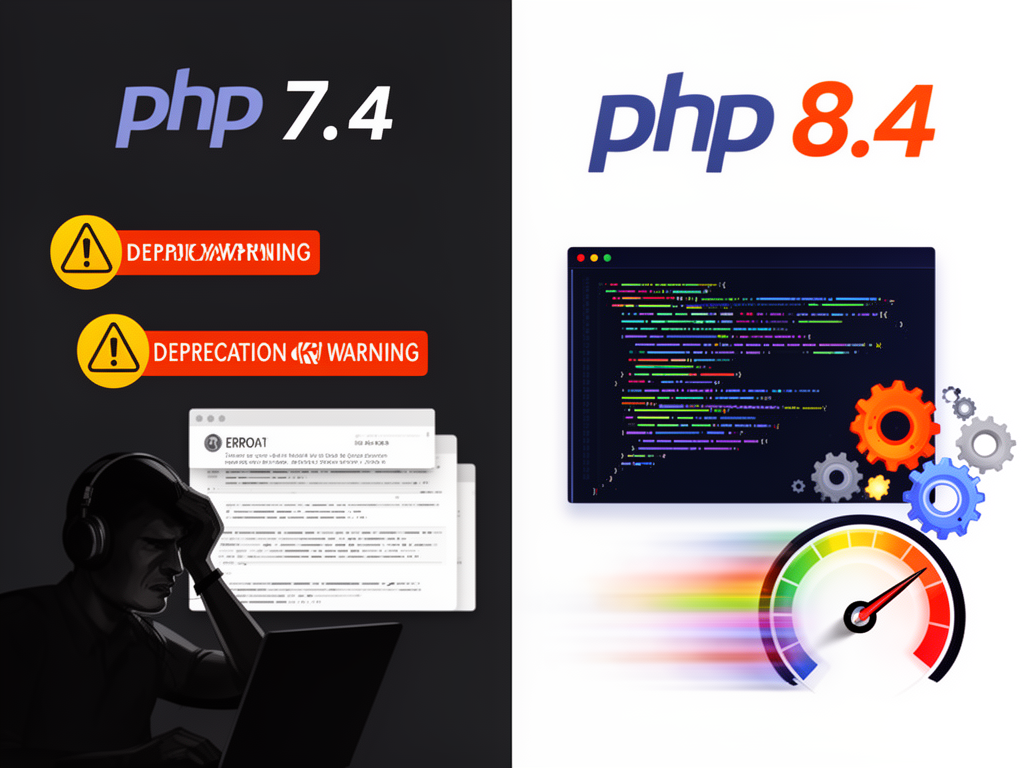
You're staring at your server control panel at 11 PM on a Thursday. A deployment just failed. Something about deprecation warnings. You scroll through the error logs, and there it is: your code works fine on PHP 7.4, but the client's server is running PHP 8.2, and suddenly half your string functions behave differently. You've been here before, haven't you?
This is the moment when version differences stop being abstract and become very, very real.
PHP has evolved dramatically over the past decade. Each major release brings performance gains, new syntax, stricter type checking, and occasionally, breaking changes that make you question your life choices at midnight. The distance between PHP 7.4 and PHP 8.4 isn't just incremental—it's a fundamental shift in how the language thinks about code, performance, and reliability.
But here's what I've learned: understanding these differences isn't just for the technically curious. It's practical knowledge that affects every project you touch, every deployment you manage, every late-night debugging session you endure.
Let's talk about what's actually changed, why it matters, and how to think about it clearly.
The evolution of PHP: from stability to agility
PHP didn't start out as a high-performance machine. It began as a simple templating language in 1995. Over decades, it evolved. Each version brought the language closer to what developers actually needed: better performance, cleaner syntax, stronger type safety, and more reliable code.
The timeline tells a story. PHP 5 arrived in 2004 with proper object-oriented programming and exceptions. Developers spent years building frameworks around that foundation. Then PHP 7 hit in 2015 and changed everything. The Zend Engine rewrote massive portions of the language from the ground up. Suddenly, PHP could execute scripts twice as fast while using half the memory. That wasn't an incremental improvement—that was a wake-up call that PHP could be fast.
Then came PHP 8 in 2020. This version introduced Just-In-Time (JIT) compilation, a feature borrowed from modern JavaScript and Python. The language started to think like a compiled language while remaining dynamically typed. Union types, named arguments, constructor property promotion, and match expressions arrived. The syntax became cleaner. The type system became more expressive. And the performance kept climbing.
We're now in February 2026, and PHP 8.4 has been stable for over a year. The ecosystem has largely moved past the early adoption phase. Yet many developers still run PHP 8.1 or even 8.0, not out of choice, but because they inherited that infrastructure, or because their hosting provider didn't upgrade yet, or because they're managing legacy applications and the migration feels too risky.
This is where understanding the actual differences becomes essential.
What separates PHP 7.4 from PHP 8.0: the first major leap
PHP 7.4 reached end of life in November 2023. If you're still running it, you're not receiving security patches. This isn't theoretical—this is a live vulnerability vector every single day.
But stepping from 7.4 to 8.0 isn't just a security upgrade. It's a mindset shift.
PHP 7.4 introduced arrow functions, typed properties, and the null coalescing assignment operator (??=). Those are nice conveniences. But PHP 8.0 introduced something different: it made the language care more about what you're trying to express.
Union types let you write function process(int|string $value): void instead of relying on inline comments or external documentation. The language now understands that your parameter could be either an integer or a string, and it can enforce that at runtime. Constructor property promotion means you can write:
public function __construct(
    private string $name,
    private int $age,
) {}
instead of:
private string $name;
private int $age;

public function __construct(string $name, int $age) {
    $this->name = $name;
    $this->age = $age;
}
This isn't just shorter. It's more explicit about intent. Anyone reading this code immediately understands what's being initialized and what scope it has.
Named arguments came too. Instead of remembering parameter order, you could call:
sendEmail(to: 'user@example.com', subject: 'Hello', body: 'Content');
This sounds small until you're debugging a function call with seven parameters and you can't remember which one goes where.
Performance-wise, PHP 8.0 introduced JIT compilation. For compute-heavy operations, WordPress benchmarks show roughly a 10-15% improvement over 7.4. That's real. That matters on busy servers.
The incremental refinement: PHP 8.1, 8.2, and 8.3
After PHP 8.0 established the foundation, the next releases refined it.
PHP 8.1 (November 2021) brought enums. If you've ever written code like:
const STATUS_PENDING = 'pending';
const STATUS_ACTIVE = 'active';
const STATUS_DELETED = 'deleted';
and then validated that strings match these values, you understand the problem enums solve. They create a dedicated type for values that can only be one of a few options. The language enforces correctness.
Enums also brought intersection types and readonly properties. Readonly means you can declare a property that can only be set once, either in the constructor or directly at declaration. This prevents accidental mutation and makes code intention clearer.
PHP 8.2 (December 2022) took it further with readonly classes. An entire class can be marked readonly, meaning all properties are immutable post-initialization. This is powerful for value objects and data transfer objects, where immutability prevents entire categories of bugs.
PHP 8.2 also deprecated dynamic properties. For decades, PHP allowed you to add properties to objects at runtime:
$user = new stdClass();
$user->name = 'John';
$user->age = 30;
This flexibility was also a footgun. Typos went undetected. Code became harder to analyze statically. PHP 8.2 deprecated this pattern, pushing developers toward declaring properties explicitly. PHP 9.0 will likely remove it entirely.
PHP 8.3 (November 2023) brought typed class constants. Where once you could only declare constants with values, now you can enforce their type:
class Config {
    public const string DATABASE_HOST = 'localhost';
    public const int MAX_RETRIES = 3;
}
This seems pedantic until a junior developer inherits your code and accidentally changes MAX_RETRIES to a string. The type system catches it.
Performance across these versions has been steady but incremental. WordPress benchmarks show roughly 2-5% improvements between point releases. Laravel sees similar patterns. The gains are compounding, but not revolutionary.
PHP 8.4: where we are now
PHP 8.4 launched in November 2024 and brings property hooks—a feature that's been requested for years. You can now define getters and setters directly in property declarations:
class User {
    public string $name {
        set {
            $this->name = trim($value);
        }
    }
}
This replaces the verbose getter and setter methods many frameworks require. It's cleaner, more declarative, more in line with how modern languages handle encapsulation.
PHP 8.4 also introduces asymmetric visibility, allowing you to declare a property as public private(set), making it readable from anywhere but writable only within the class. This prevents unnecessary defensive copying and getter methods.
New array functions like array_find(), array_all(), and array_any() simplify common patterns. Lazy objects allow you to defer object initialization until actually needed. The DOM extension now supports HTML5 properly, not just XML-shaped HTML.
Performance-wise, PHP 8.4 hovers around 2-3% faster than 8.3 for most applications. This is normal. Major versions still see occasional dramatic jumps (like 7 to 8), but incremental releases show diminishing returns. This is expected and healthy.
Why this matters: WordPress and the real world
Here's where theory meets practice: WordPress 6.9 now fully supports PHP 8.3 and has beta support for 8.4. If you're running WordPress, you have clear guidance. PHP 8.2 or 8.3 balances stability with modern features.
But WordPress is one ecosystem among thousands. Laravel has similar compatibility charts. Symfony, Drupal, Magento—each has its own timeline.
The real question isn't "what's the best PHP version?" The real question is "what's the best version for this specific project right now?"
For WordPress sites, PHP 8.2 or 8.3 work. For e-commerce platforms where security and performance matter equally, PHP 8.2 or 8.4 makes sense. For legacy applications you're maintaining but not actively developing, PHP 7.4 might still be running, and you need a migration plan.
The key detail: PHP versions follow a three-year support lifecycle—two years of active support plus one year of critical security patches. After that, you're on your own.
This changes the mathematics of your upgrade decision. If you deploy a new project on PHP 8.1 today (February 2026), active support ends in November 2023—which was already over two years ago. That version is in security-fix-only mode. If you deploy on PHP 8.4, you have until late 2027 before security patches stop.
That's real planning material.
Making the upgrade: from understanding to action
Knowing the differences is one thing. Actually migrating is another.
I've watched projects get stuck because someone wrote code that relied on PHP 7.4 behaviors, and when they upgraded to 8.0, string operations behaved differently, array functions returned different types, and object handling changed in subtle ways. The code didn't break completely—it just… didn't work right.
This is where tools like Rector come in. Rector isn't a linter. It's an automated code refactoring tool that scans your entire codebase, identifies deprecated patterns, and can automatically update them to modern PHP standards. It runs in dry-run mode first, showing you what would change before you commit anything.
For a large project, this is invaluable. Instead of manually hunting through thousands of lines of code for deprecated function calls or outdated type patterns, Rector finds them systematically.
The process looks like this:
- Analyze your current codebase with Rector in dry-run mode
- Review the proposed changes
- Run Rector to apply transformations automatically
- Test thoroughly (unit tests, integration tests, staged deployment)
- Migrate slowly if needed
For smaller projects or careful rewrites, you might do this manually. For anything substantial, automation saves time and reduces human error.
There's also the question of compatibility. WordPress 6.6 (July 2024) dropped support for PHP 7.0 and 7.1, raising the minimum to 7.2.24. This happens regularly. Your framework or CMS will eventually force the conversation.
The smart move is to plan ahead. If you know support for your current version ends in November, start testing upgrades in August. Run your test suite against the next major version. Identify what breaks. Fix it incrementally.
The performance reality: is it really faster?
Yes. But not always in the way you expect.
PHP 8.4 can execute requests about twice as fast as PHP 7.4 in high-performance frameworks like Laravel. That's significant. On a busy server, doubling throughput changes everything—you handle more traffic with the same hardware, or serve the same traffic with less hardware.
But performance gains accumulate unevenly. Simple CRUD operations on a typical WordPress site might see 5-10% improvements. Compute-heavy operations benefit more from JIT compilation in PHP 8.0+.
The real gains often come from:
- Type safety reducing runtime errors – fewer exceptions thrown, fewer error handlers executing
- Better memory management – newer versions handle object allocation more efficiently
- Cleaner syntax requiring less code – less code to parse and execute
- Framework optimizations – Laravel, Symfony, and others have optimized their code for PHP 8 features
Your application might not feel dramatically faster. But it'll be more stable, more secure, and easier to maintain. And on large traffic volumes, those percentages compound into real cost savings.
Security: the part you can't ignore
This is where the conversation stops being optional.
PHP 7.4 lost active support in November 2023 and reached end of life in November 2023. If you're running it in production, you're not receiving security patches. Every new vulnerability discovered is a potential breach.
This isn't hypothetical. Vulnerabilities in PHP core emerge regularly. They're usually patched quickly, but only in supported versions. If you're on end-of-life software, you're vulnerable.
WordPress dropped support for PHP 7.0 and 7.1 in mid-2024, and will continue forcing upgrades as time passes. Your framework will do the same. The industry is moving toward the principle that you must run a supported version.
If your hosting provider claims they "still support PHP 7.4," they're likely not. They might allow it to run, but Zend doesn't release patches anymore. Your provider's security patches don't reach the core language vulnerabilities.
This is the hard conversation to have with non-technical stakeholders. "We need to upgrade PHP" doesn't sound exciting. But "we're running software that hasn't received security updates in over two years" is harder to defend.
The ecosystem: what actually matters
Here's what I've learned managing projects of different sizes: the version you choose matters less than choosing one that's supported and sticking with a clear upgrade plan.
A client running PHP 8.1 on a two-year-old codebase is in a better position than one running PHP 8.4 on incompatible libraries. Consistency and forward planning matter more than having the absolute latest.
When hiring PHP developers, understanding version differences matters too. A developer who can confidently explain the progression from 7.4 to 8.4 likely understands the language deeply. Someone who insists on the newest version regardless of project needs might not.
For platform like Find PHP, this matters. When you're looking to hire or be hired, version compatibility and upgrade skills are real qualifications. A developer who's navigated a migration from PHP 7 to PHP 8 understands the complexity and has the scars to prove it.
Choosing your path forward
If you're building something new today, PHP 8.4 is the clear choice. You have five years of active support ahead. The features are modern. The performance is solid.
If you're maintaining WordPress, PHP 8.2 or 8.3 balance stability with modern language features. You'll have support through at least 2025 (8.2) or 2026 (8.3).
If you're managing legacy applications, create a migration timeline. PHP 7.4 won't receive patches forever. Start testing PHP 8.0 now. Plan the actual migration. This isn't a weekend project—it's a series of small, careful steps.
If you're trying to hire PHP developers, don't just ask "what's your experience?" Ask "have you migrated a codebase across major PHP versions?" That's the answer that matters. That's experience.
The distance between PHP 7.4 and PHP 8.4 is the distance between a language that was functional and one that's expressive. Between a runtime that was fast enough and one that's truly performant. Between defensive programming where you checked everything and confident programming where the language checks for you.
These aren't just technical improvements. They're a shift in how we think about writing reliable, maintainable code at scale.
The choice of which version to use isn't about being fashionable or cutting-edge. It's about understanding the tradeoff between stability and capability, between the known and the new, and making a deliberate decision that fits your actual situation.
And that deliberation, that care, that's where real craftsmanship lives.