Contents
Long-term career planning for PHP developers
There's a moment that comes to most PHP developers around year five or six when the initial excitement starts to shift. You've shipped features, fixed production bugs at 2 AM, navigated framework migrations. The code that once felt impossible to write now flows from your fingers almost without thinking. And suddenly you're standing at a crossroads, asking yourself: What happens next?
This is where most of us falter. We assume the path forward is obvious — climb the ladder, earn more, get the title. But long-term career planning isn't about following a predetermined map. It's about understanding who you want to become as a developer, what kind of problems energize you, and how to build a sustainable, meaningful career in an industry that never stops changing.
Let me share what I've learned, and what the landscape looks like for PHP developers in 2026.
Understanding where you actually are
Before you can plan forward, you need brutal honesty about where you stand. Not just your technical level, but your situation holistically. Are you stuck in a role that's comfortable but unchallenging? Are you switching between frameworks constantly and never mastering any of them? Are you burning out because you're trying to learn everything at once?
The first step isn't adding skills to your resume. It's reflection.
Ask yourself these questions:
- What did I love about the last project I shipped?
- What meetings drain my energy?
- Do I want to write code in five years?
- Am I learning something new every week, or am I repeating the same year twelve times?
- When I'm stuck on a problem, do I feel frustrated or fascinated?
Your answers here matter more than your GitHub contributions. They point toward the truth about what kind of career you actually want to build. Because here's the thing nobody tells you: just because you can become a staff engineer, CTO, or security specialist doesn't mean you should. The best PHP developers I know made deliberate choices about their path. They didn't default into it.
The foundation: skills that compound
There's a hierarchy of learning in PHP. At the bottom are syntax and frameworks — tools that let you build things today. At the top are patterns of thinking that make you dangerous anywhere you work.
If you're thinking long-term, Object-Oriented Programming and design patterns aren't optional anymore. This isn't about sounding smart in code reviews. When you truly understand OOP, when MVC architecture becomes intuitive, when factory patterns feel natural, you stop thinking about the mechanics of coding and start thinking about solutions. That shift unlocks everything else.
Pair this with SQL mastery. I mean real mastery. Not just SELECT * FROM users WHERE id = 1. Understand indexing, query optimization, the relationship between your ORM and the actual database. Most PHP developers treat the database like a black box. The ones who understand it? They become the people everyone leans on.
Then add modern frameworks. Laravel or Symfony — pick one and go deep. These frameworks aren't just tools; they're libraries of industry knowledge baked into architecture. When you stop fighting them and start understanding their philosophy, your code gets better. Your career options multiply.
Version control beyond git push is essential. Understand branching strategies, collaborative workflows, why your team needs standards. Git is how modern teams work. Master it and you become more valuable everywhere.
And here's the uncomfortable truth: soft skills become your ceiling. A brilliant developer who can't communicate is an island. Long-term, communication, collaboration, and the ability to translate between technical and business thinking matter more than your ability to optimize a database query. This isn't optional. This is how you don't get stuck.
The strategic middle: the next five to ten years
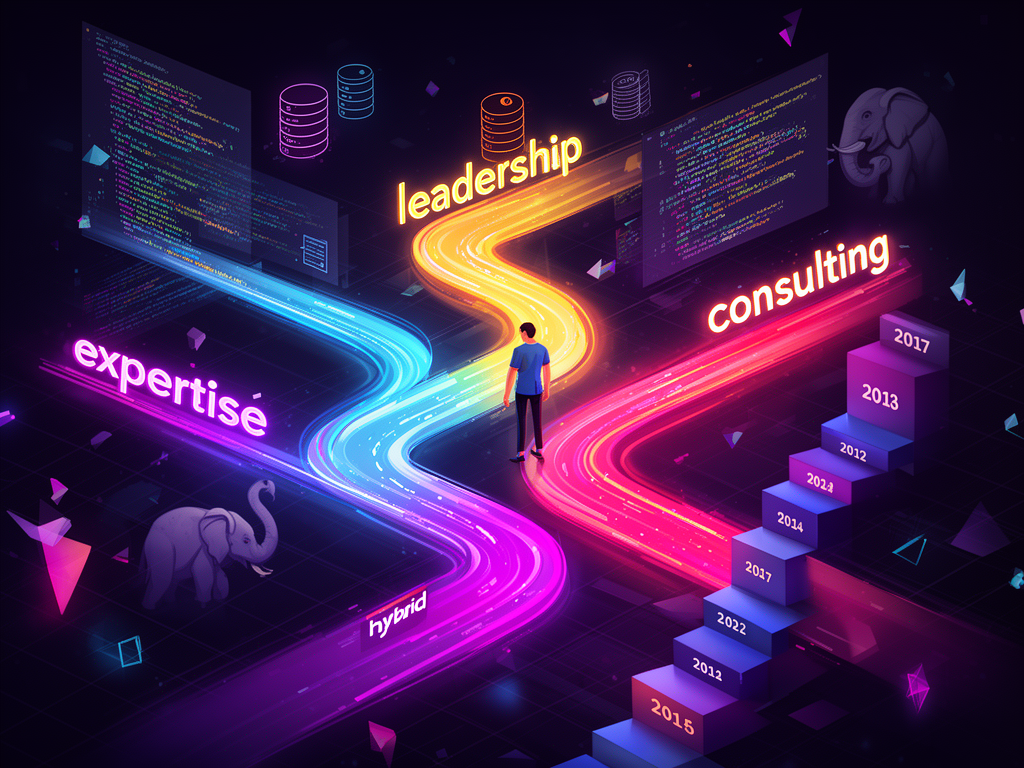
This is where career planning gets real. The path from mid-level developer to whatever comes next splits into several directions. You don't have to choose only one, but being intentional about it changes everything.
The technical depth path: Become the expert. Specialize in something real — database performance, API design, security, DevOps infrastructure. At find-php.com, developers who can credibly say "I architect scalable PHP systems" command respect and opportunity. This path requires consistent focus. You pick a domain and spend years becoming unremarkable except when it matters.
The leadership path: Move toward people and decisions. This doesn't mean you stop writing code, but it means your impact shifts from "I built this feature" to "I helped this team build three products." Technical leadership — lead developer, tech lead, architect — becomes possible. The transition here is subtle and often uncomfortable. You need to learn to think in systems and people, not just code. Some developers thrive here. Others discover they hate it. Both outcomes are valuable to know early.
The independent path: Consulting, freelancing, or building your own product. PHP is still the engine of the internet. Small businesses need reliable developers who understand their problems. Building reputation, a portfolio, client relationships — this takes time, but the autonomy and variety matter to some people deeply.
The hybrid path: The most common and often the most sustainable. You stay deeply technical, but you're opinionated about architecture. You mentor others informally. You contribute to open-source. You're the person people ask when decisions get hard. You're not a manager, but you influence how things get built.
The trick here is choosing intentionally by year five. Not forever — people change. But having a direction means your learning focuses. It means you choose projects that build toward something. It means you're not just accumulating random skills; you're deepening expertise in a direction that matters to you.
Building the machine: systems that scale
Career planning isn't just about skills. It's about building systems that keep you growing without burning out. Think of it like infrastructure. Poor infrastructure collapses under load. Good infrastructure scales.
Continuous learning needs structure. Not "I'll learn when I find time" — because you won't. Find time gets crushed. Set real patterns. Dedicate two hours a week to something that interests you. Not work. Not urgent things. Learning. Make it sacred. Maybe it's working through a course on advanced PHP 8 features. Maybe it's contributing to an open-source project. Maybe it's writing about something you've learned. The format matters less than the consistency.
Your network is not optional. I know developers who've stayed in jobs for years that hurt them because they didn't have other options. Developers in community are different. They're connected to opportunities before they become public. They hear about good teams, interesting projects, emerging trends. Join PHP communities on GitHub, Stack Overflow, Reddit. Attend conferences when you can. Contribute to open-source projects not because it's noble, but because it introduces you to people. Real connections, real learning, real opportunities come from spending time around good developers doing things that matter.
Build something visible. A blog. A side project. A portfolio. Contributions you can point to. This isn't about ego. It's about signal. When a company is evaluating PHP developers, they're trying to understand how you think and what you care about. Your blog about debugging strategies tells them something real. Your GitHub projects show decisions you've made. Your open-source contributions reveal how you collaborate. This is how you become findable to the right opportunities.
Mentorship works in two directions. Junior developers are often eager to learn from you. Let them. Teaching forces you to articulate knowledge you've assumed. It also keeps you honest — if you can't explain it clearly, you don't understand it as deeply as you thought. Meanwhile, find mentors ahead of you. Not necessarily formal mentorship. But developers you respect who are two or three steps further in a direction you want to go? Pay attention. Ask questions. Buy them coffee. Most good developers remember being stuck and want to help.
Negotiate deliberately. This is where long-term planning meets reality. Salary doesn't just "happen." Neither do good working conditions, learning opportunities, or flexibility. Every few years, have real conversations about compensation. Every time you interview, understand your market value. Salary compounds. If you stay $5,000 underpaid for five years, that's a real cost to your future.
The landscape for PHP in 2026
PHP gets talked down a lot. People joke about it, predict its death, suggest you should learn JavaScript or Go instead. Ignore that noise.
PHP powers a massive percentage of the web. WordPress, Laravel ecosystem, Symfony, custom applications at massive scale — PHP isn't going anywhere. But the market has changed. Generalist PHP developers are commodity now. Specificity matters.
Developers with deep Laravel expertise are in demand. So are people who understand modern DevOps — Docker, cloud deployment, infrastructure as code. Developers who can speak intelligently about APIs and system design. People who've thought seriously about security and performance.
What's less valuable: being a generalist who knows a bit of everything. What's valuable: being someone who knows their domain deeply and keeps learning at the edges.
The companies hiring seriously for PHP in 2026 are looking for developers who can grow into the next role. Who think about architecture, not just features. Who understand the business context of their work. Who communicate clearly. Who take ownership.
If you're building your career intentionally around these things, you're moving against the current of what most PHP developers do. And that's exactly where opportunity lives.
When doubt creeps in
Here's something real that nobody talks about: long-term career planning requires faith in yourself that wavers. There will be moments when you question if you chose wrong. If PHP is a dead end. If you should have learned Rust or jumped to frontend. If you're falling behind.
These moments are normal. They're not signs you chose wrong. They're signs you're paying attention to a fast-moving industry. But here's what helps: remember that the PHP developers genuinely thriving in 2026 aren't the ones who learned the most languages. They're the ones who went deep. Who built real expertise in something real. Who stayed connected to their community. Who kept learning but didn't chase every shiny thing.
Your career is measured in years, not in trending topics on Twitter. The skills that matter compound slowly. The relationships you build have exponential value. The problems you solve become part of your thinking forever.
The developers who regret their PHP careers usually regret one thing: they drifted. They didn't plan. They took whatever job paid the most. They didn't invest in learning. They isolated themselves.
The ones who feel genuinely good about their PHP career? They made choices. They invested in themselves and their community. They stayed curious without losing focus. They moved deliberately.
Long-term career planning for PHP developers isn't complicated. It's just intentional. It's asking yourself the hard questions now instead of five years from now. It's building systems that keep you growing. It's investing in people and knowledge. It's making deliberate choices about the direction you're heading, knowing you can always adjust course.
You're not defaulting into a career. You're building one. And that choice, made consciously and revisited regularly, is what separates developers who drift from developers who actually thrive. The path forward isn't predetermined, but it's absolutely within your control to shape it deliberately, one intentional decision at a time.