Contents
- 1 How to get your first job as a PHP developer
- 2 The myth of “ready” (and why PHP is secretly kind to beginners)
- 3 What you actually need to know (not the full internet)
- 4 Projects that actually impress hiring managers
- 5 How to talk about your “lack of experience” without apologizing
- 6 Networking for people who feel allergic to networking
- 7 The CV and portfolio that don’t pretend
- 8 Applying without burning out (or ghosting yourself)
- 9 How to not freeze during technical interviews
- 10 Freelancing and “unsexy” gigs as your first stepping stone
- 11 Where platforms like “Find PHP” quietly change the game
- 12 The part nobody tells you: emotional resilience
How to get your first job as a PHP developer
There’s a moment many of us remember too clearly.
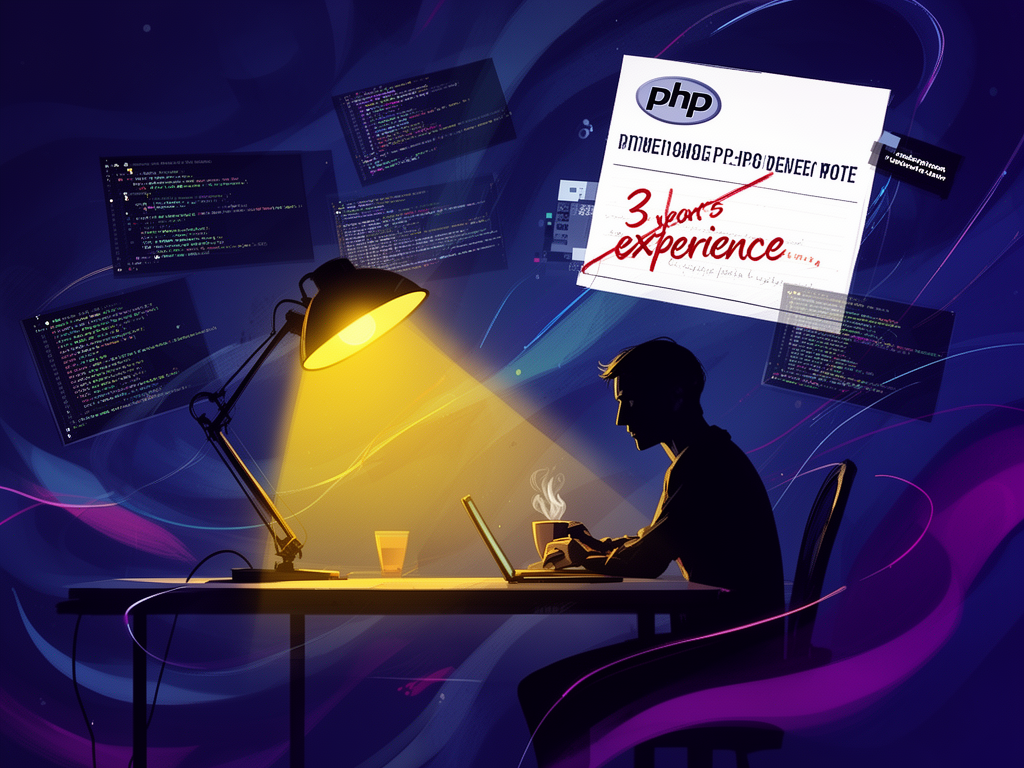
It’s 1:17 a.m.
Your room is lit by a monitor and a cheap desk lamp that makes everything look slightly yellow.
You’ve got three tabs open:
- a failed
composer install, - a Laravel tutorial on YouTube paused at “now this part is important,”
- and a job listing asking for 3 years of PHP experience… for a junior role.
You scroll through the requirements and feel that familiar, sinking “I’m not ready” feeling.
If you’re somewhere in that scene right now, this article is for you.
I want to talk about how to get your first PHP developer job in a way that’s honest, practical, and grounded in the messy reality: impostor syndrome, badly written job posts, unpaid “test” tasks, portfolio shame, all of it.
Not as a recruiter.
Not as a bootcamp landing page.
As one developer to another.
Let’s walk through the path. Not the fantasy path. The real one.
The myth of “ready” (and why PHP is secretly kind to beginners)
Have you noticed how “How to become a PHP developer” articles usually start?
- “Get a bachelor’s degree.”
- “Master data structures and algorithms.”
- “Learn three frameworks, two front-end libraries, and 27 buzzwords.”
Meanwhile in the real world, half the stuff that got many of us hired for the first time was:
- being able to debug a broken login,
- making a contact form actually send an email,
- not panicking when something 500s in production.
Here’s the quiet truth: PHP is still one of the most forgiving ways into web development.
The ecosystem is huge.
There are piles of legacy projects quietly running entire businesses.
And a lot of those businesses need someone who:
- doesn’t run away when they see PHP 7.4 or WordPress,
- can learn enough Laravel or Symfony to not burn the place down,
- can communicate like a functional human being.
Hiring managers are not sitting there with a clipboard waiting for you to recite the full SPL by heart. They are asking themselves one thing:
“If I put this person next to our codebase for three months, will they move us forward or slow us down?”
Your job is to prove you are the first kind of person.
To do that, you need three things:
- skills that map directly to what teams actually do in PHP land,
- visible proof of those skills,
- a way to get in front of people who care.
Degrees help some people. Certifications impress some managers. But the engine behind your first PHP job is much more basic.
Let’s start with the skills, but in a way that’s connected to real work, not just course checklists.
What you actually need to know (not the full internet)
When people say “learn PHP,” they often mean “absorb the entire ecosystem and never feel insecure again.”
That will never happen.
So instead, imagine a small web agency. They build and maintain:
- a few Laravel or Symfony apps,
- a couple of WordPress or custom PHP sites,
- some APIs that talk to mobile apps or front-end SPAs.
What do they need you to do, realistically, in your first 3–6 months?
- Fix bugs without breaking everything else.
- Add small features end-to-end.
- Understand enough of the stack to not be dangerous.
- Ask questions early instead of silently drowning.
That maps to a sane learning set:
Core PHP
- variables, arrays, strings, loops,
if/else - functions, basic OOP (classes, objects, methods, properties)
- namespaces, autoloading (
composerbasics) - working with dates, files, and simple error handling
Web basics
- HTTP: GET/POST, headers, status codes
- forms: processing input, validation, sanitization
- sessions and cookies (basic auth flows)
- JSON and simple APIs
Frontend minimum
- HTML: structure, forms, tables, semantic tags
- CSS: layouts, responsive basics, how to not completely destroy a layout
- JavaScript: enough to understand and tweak simple scripts, validate a form, handle click events
Databases
- SQL: SELECT/INSERT/UPDATE/DELETE, joins, indexes conceptually
- one database engine (MySQL or PostgreSQL is fine)
- using PDO or an ORM like Eloquent (Laravel) or Doctrine (Symfony)
A modern PHP framework
Pick one popular framework and go deeper rather than skimming five:
- Laravel (probably the friendliest starting point),
- or Symfony if your market leans that way.
You should be able to:
- create routes and controllers,
- render views (Blade/Twig),
- work with models and migrations,
- handle basic validation and authentication.
Ecosystem basics
- Composer: install packages,
composer.jsonmeaning - Git: clone, branch, commit, push, pull request
- Environments: local vs staging vs production,
.envbasics
That’s plenty. More than enough to be useful.
Notice what’s missing:
- You do not need Kubernetes.
- You do not need to memorize every PHP 8.3 feature.
- You do not need to build your own framework “to understand how it works from scratch.”
Instead: you need to be able to build small, boring, real things.
Because your first PHP job is 80% small, boring, real things.
Projects that actually impress hiring managers
Let’s be blunt: another “To-do app in Laravel” doesn’t make anyone’s heartbeat increase.
Hiring managers are not looking for perfection. They’re looking for signals:
- “Will this person finish things?”
- “Do they think in terms of users, not just code?”
- “Can they read existing code and fit into a style?”
So when you think about projects for your portfolio, optimize for that.
You don’t need ten projects.
You need three that look and feel like something a small business might pay for.
Here are some suggestions that map directly to common PHP work.
1. A simple client-style CRUD app
Example: “Project tracker” or “Small inventory/booking system”
Stack idea:
- Laravel or Symfony,
- MySQL,
- Bootstrap for UI.
Features:
- authentication (register/login/reset password),
- create/update/delete items (projects, products, bookings),
- user-specific data (each user sees their own stuff),
- maybe a very simple role system: admin vs normal user.
Bonus points:
- form validation with user-friendly errors,
- pagination and search,
- seeds/factories for test data.
This screams “I can survive inside a real PHP application.”
2. A public-facing site with a CMS-like back office
Example: “Local café website with admin panel”
Stack idea:
- Laravel or even plain PHP with a simple MVC structure,
- MySQL,
- minimal JS.
Features:
- public pages: menu, about, contact,
- admin login for café owner,
- admin can edit menu items and opening hours,
- contact form that sends email and saves messages to database.
Bonus points:
- basic SEO-friendly URLs and meta tags,
- responsive layout that doesn’t break on mobile.
This shows that you understand the usual “marketing site + admin” pattern that keeps the PHP world running.
3. An API that a front-end (or mobile) could use
Example: “Task management API”
Stack idea:
- Laravel API routes,
- JSON responses,
- maybe a simple front-end or Postman collection to show usage.
Features:
- endpoints for auth,
- endpoints for CRUD operations,
- basic auth layer (token or Laravel Sanctum),
- input validation and proper HTTP codes.
This signals you can exist in a modern stack where PHP is mostly an API layer.
Make your projects feel “hireable”
Raw code isn’t enough. Make each project look like something that actually exists in a company.
For each project, include:
- a README that explains what it does in plain language,
- screenshots or a short GIF,
- install instructions:
git clone,.env,composer install,php artisan migrate, etc., - a short note on stack choices: why Laravel? why MySQL?
Host them:
- code on GitHub or GitLab,
- live demo on cheap hosting, a VPS, or something like Laravel Forge / Ploi / shared hosting.
Even a subdomain on some budget provider beats “run php -S to test this.”
A recruiter or team lead being able to click a link and play with your app for 2 minutes does more for you than five extra bullet points on your CV.
How to talk about your “lack of experience” without apologizing
There’s a tricky moment in every interview.
They ask: “So, how much experience do you have with PHP professionally?”
And the truthful answer is: “None. That’s why I’m here.”
You have two options:
- shrink and apologize,
- or be honest and show how you’ve already been acting like a professional.
Something like this:
“I don’t have commercial PHP experience yet, but for the past six months I’ve been working like I’m on a real team. I built three projects: a small CRM-like app, a CMS-style website, and a JSON API. All are on GitHub with tests, docs, and live demos. I also contributed to an open source Laravel package by fixing a small bug. Now I’m looking for a place where I can do this with teammates, code review, and real users.”
Same facts. Different energy.
You’re not begging for a chance. You’re showing you’re already moving and you want to plug that motion into their company.
Networking for people who feel allergic to networking
“Network more” is awful advice when you’re imagining cheesy meetups and forcing small talk next to a tray of dry sandwiches.
Instead, think “networking” as:
finding ten humans who know you exist and vaguely trust you with PHP.
That’s it.
Here are ways to do that without becoming someone you hate.
1. Become a regular somewhere
Pick one or two PHP communities, not ten:
- an online forum or Discord,
- a Laravel or Symfony Slack,
- a local PHP user group if there is one,
- the community around platforms like Find PHP where PHP devs and companies intersect.
Then:
- answer beginner questions where you can,
- share your small wins (“Just deployed my first Laravel app to production-like hosting”),
- ask questions that show you tried first.
Over a few months, you’ll notice names you recognize. Some of those people will be hiring or know someone who is.
2. The “SIBA” style move: solve first, talk later
Inspired by that “Solve Issues Before Applying” idea: you can adapt it to PHP.
- Find a small open source PHP project (a Laravel package, a small tool, a WordPress plugin) that you actually use or find interesting.
- Look at open issues. Pick something labelled “good first issue” or minor bug.
- Try to fix it. If you get stuck, ask in their issues tab with specific questions.
- Open a clean pull request.
Best case: your PR gets merged, you’ve got a public contribution and maybe a maintainer who remembers your name.
And when a company sees “Contributed to X,” it signals: you can read other people’s code, follow instructions, and improve something you didn’t write.
3. Micro–mentors, not a single “senior savior”
Instead of hunting for one mentor to “guide your career,” look for micro–mentors:
- that one mid-level dev on Discord who explains things clearly,
- that senior in your city who’s willing to look at your portfolio once,
- that freelancer who shares how they price small PHP gigs.
You can send a short, respectful message like:
“Hey, I’m trying to get my first PHP developer role. I built a small Laravel project (link) and I’d love any blunt feedback on what would scare you off as a hiring manager.”
Some won’t reply. Some will send gold.
People are often more willing to help when your question is concrete and you already did the hard work.
The CV and portfolio that don’t pretend
Let’s talk about the thing everyone hates writing: the CV.
You do not need to pretend you were “Senior Web Solutions Engineer” because you edited a WordPress theme once.
You can be honest and still sound like someone worth hiring.
CV structure that actually works for junior PHP devs
- Contact & links: email, city/region, GitHub/GitLab, portfolio, maybe LinkedIn.
- Headline: “Junior PHP developer focusing on Laravel + MySQL” is clear and direct.
- Skills: short, focused list, roughly grouped:
- Languages: PHP, SQL, JavaScript, HTML, CSS
- Frameworks/Tools: Laravel, Composer, Git, PHPUnit (if true)
- Databases: MySQL, PostgreSQL (if true)
- Projects: 3 core ones, each with:
- name + one-line description for humans,
- stack,
- what you personally implemented,
- link to repo and live demo.
- Experience: include non-tech jobs, but translated:
- “Handled 30+ customer interactions per day, documented issues clearly, and followed defined processes” can absolutely matter to a dev team.
- Education / courses: degree if you have it, bootcamps, notable courses (but don’t list every playlist you watched).
No need for 3 pages. One is usually enough.
Portfolio: show, don’t recite
On your portfolio site (or GitHub README if that’s your main “home”):
- put screenshots right near the top,
- add short “stories” for each project:
- what problem it solves,
- what tech you used,
- what you struggled with and how you solved it.
That last part is underrated.
“I struggled with N+1 queries when listing orders. I solved it using Eloquent eager loading (
with('items')) and verified the number of queries using Laravel Debugbar.”
That sentence tells a hiring manager: you know what you’re doing more than any “I am a hard-working team player” ever will.
Applying without burning out (or ghosting yourself)
You will be tempted to do one of two extremes:
- apply to 200 jobs with a generic CV and generic message,
- or spend three weeks polishing your CV and never click “submit” anywhere.
Neither works.
Think of job applications like experiments. Each one is a data point. You want lots of data, but with some intention.
The 70/20/10 approach
Roughly:
- 70%: apply to roles where you fit maybe 60–70% of the description.
- 20%: stretch roles that scare you a little.
- 10%: “dream” roles that seem out of reach but not absurd.
For each one:
- tweak your CV headline and project order to match what they care about,
- write a short message that shows you read the posting:
- “I noticed you’re using Laravel + Vue. My last project uses Laravel with a REST API consumed by a JavaScript front-end; I’d love to help on the backend side.”
Ignore the “3 years of experience” trap
Many “junior” roles still say “2–3 years of experience.”
Often this means: “We want someone who can work mostly independently, but we’re not ready to pay mid-level yet.”
If the stack matches what you know and the description isn’t insane, apply anyway.
Your portfolio and projects can substitute for that missing year count.
The worst they can do is ignore your email. You’re already being ignored by companies you never applied to. You lose nothing.
How to not freeze during technical interviews
Let’s picture it.
You’re in a video call. The interviewer shares a coding exercise:
“Write a function in PHP that takes an array of orders and returns the total revenue for completed ones. Talk through your thinking.”
Your heart rate doubles. Your brain suddenly forgets what foreach looks like.
Here’s the mindset shift that helps:
They’re not just testing correctness. They’re testing how you think and how you react under stress.
You can absolutely say things like:
“I’m a bit nervous, so I’ll talk it out as I go.”
And then:
- restate the problem in your own words,
- think out loud: “So I only count orders with status === 'completed', then sum their amounts”,
- start simple and refine if needed.
If you get stuck on syntax, you can say:
“I’m blanking on the exact function name, but I’d normally check the PHP docs here. Roughly, I’d loop through with
foreach, check status, and add to a$totalvariable.”
For junior roles, many interviewers will help you along. They’re screening out people who give up, not people who occasionally forget where the semicolon goes.
If they’re hostile about it? That’s its own kind of feedback about the team culture.
Freelancing and “unsexy” gigs as your first stepping stone
Your very first PHP income might not say “Software Engineer” on the contract.
It might be:
- tweaking a WordPress plugin for a friend’s shop,
- integrating a payment gateway into a small Laravel app,
- building a tiny booking form for a yoga studio.
Some people will tell you that this isn’t “real experience.” Those people have often forgotten their own first steps.
Client work — even tiny, chaotic client work — teaches you:
- how to ask clarifying questions,
- how to ship something by a date,
- how to debug problems in environments you don’t control,
- how to say “no” when someone wants ten features for the price of one.
Freelance platforms, local businesses, even barters (“site for your small café in exchange for X”) — all of these can become real bullet points on your CV if you treat them seriously and document them.
And in the PHP ecosystem, especially around small agencies and product shops, people respect “I built four real things for actual humans” more than “I watched 90 hours of tutorials and did all the quizzes.”
Where platforms like “Find PHP” quietly change the game
One thing that’s shifting in the PHP world is the infrastructure around it.
So many of us had to:
- scatter our portfolio across random GitHub repos,
- send CVs into black holes,
- rely on general job boards that lump PHP together with “also must know Rust, Go, and run the finance department.”
Platforms that focus specifically on PHP, like Find PHP, change the terrain slightly in your favor.
They exist in that intersection of:
- people looking for PHP jobs who can actually write PHP,
- companies that actively need PHP developers (not “Node, maybe PHP if you’re bored”),
- a community that cares about the PHP ecosystem specifically.
That means when you show up there with:
- a clear profile,
- honest skill listing,
- a couple of solid projects,
you’re surrounded by people who speak the same language — composer, artisan, migration hell, PHP version upgrades — instead of being treated as a generic “web dev.”
Use that to your advantage.
Treat your presence there as your “PHP business card”:
- link to it from your GitHub,
- keep it updated when you ship a new project,
- write in your bio like you’re talking to another dev, not a faceless HR bot.
It’s a place where your intent (“I want to grow in PHP”) aligns with the platform’s purpose (“We’re here for PHP work and PHP people”), and alignment matters more than we admit.
The part nobody tells you: emotional resilience
We can talk forever about Laravel, portfolio structure, or which cloud provider is trendy. But your first PHP job probably won’t hinge on that.
It will hinge on these unglamorous skills:
- being able to read a rejection email and not make it a verdict on your worth,
- opening your editor again the next day,
- finishing that last bit of validation code even though nobody is watching,
- sending one more application after the last three ghosted you.
Getting into tech, especially into PHP where the narrative online sometimes says “it’s old,” can feel like you showed up late to the party.
You didn’t.
There’s an entire quiet economy of PHP out there: shops, agencies, legacy systems, new SaaS tools, e-commerce engines, internal dashboards. They don’t always scream on social media, but they’re very real, and they need people who can care about code and users at the same time.
Maybe that person is you, sitting in front of a glowing screen, with a half-broken local dev environment and a head full of doubts.
If you keep learning deliberately, build a few honest projects, let a few real humans see your work, and stay in the game long enough, something shifts.
At some point, an email lands in your inbox with a subject line that doesn’t say “Unfortunately.”
It says:
“PHP developer – let’s talk.”
And that moment — quiet, unreal, slightly terrifying — is often less about genius and more about stubbornness, patience, and those long, yellow-lit nights you decided not to give up.