Contents
When to rewrite PHP code from scratch
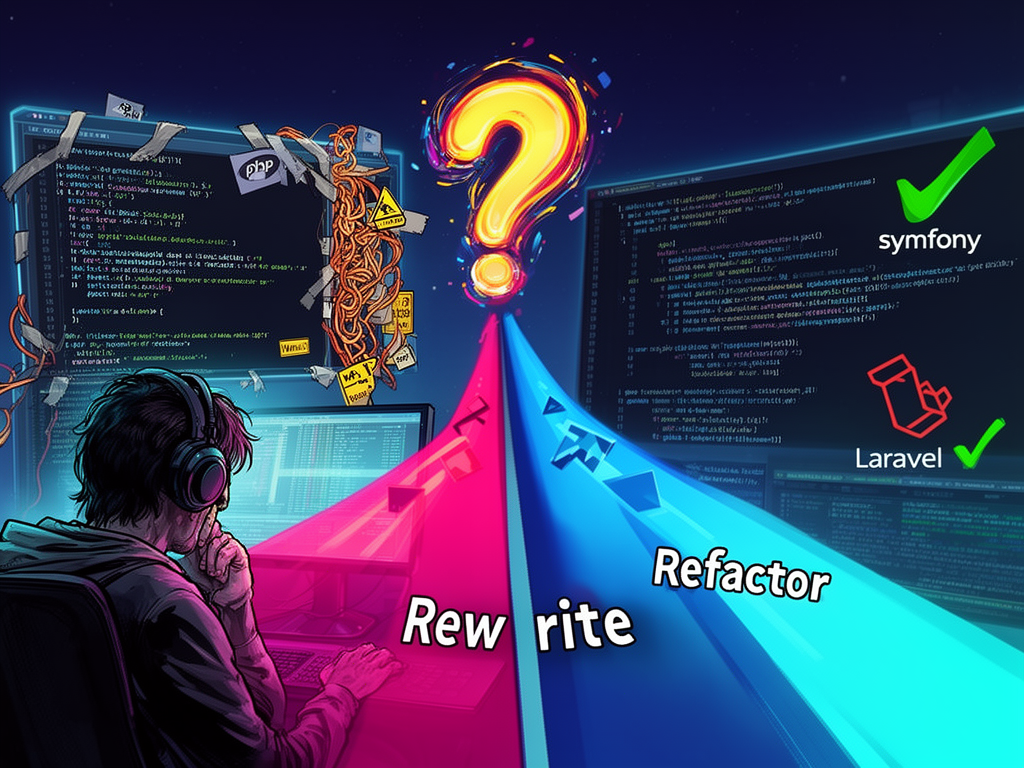
Fellow developers, picture this: it's 2 AM, your screen's glow is the only light in the room, and you're staring at a PHP codebase that's been limping along since the WordPress 3.x days. Bugs pile up like unread emails, deadlines whisper threats, and every fix feels like patching a sinking ship with duct tape. You've been there—haven't you? That moment when you wonder: Should I just nuke it all and start fresh?
I've felt that pull too many times. Rewriting from scratch promises a clean slate, modern PHP 8.3 features, zippy performance, and code that doesn't make you cringe. But here's the quiet truth I've learned after too many all-nighters: rewrites are seductive traps. They rarely deliver without massive pain. Most times, smart refactoring wins. But not always. Let's unpack when to rewrite, when to refactor, and how to decide without regret.
The siren call of the full rewrite
Rewrites feel heroic. Throw out the spaghetti code, embrace Symfony or Laravel anew, deploy to Kubernetes, and bask in the glory. I remember my first big one—a monolithic e-commerce app on PHP 5.6. We rewrote it in a "quick" six months. It shipped late, cost double the budget, and missed key features because we chased perfection. The business suffered.
Sources like SensioLabs nail it: rewrites make sense only in rare cases. Think truly obsolete tech stacks—PHP 5.3 or earlier, where security patches dried up years ago. Or when business needs have shifted fundamentally. Your app started as a blog but now powers an AI-driven marketplace? The old architecture chokes. Same if it can't support must-have features, like real-time WebSockets on a procedural mess.
Zend echoes this: rewrites mean starting from scratch, ditching incremental gains. High risk, especially if uptime is non-negotiable. Clients don't care about your clean code if the site 500s during Black Friday.
But ask yourself: Is your pain that acute? Or is it just accumulated tech debt screaming for air?
Why refactoring usually saves your soul
Refactoring isn't sexy. It's the unglamorous grind of tiny wins. Made with Love calls it a "field guide" to modernization without the rewrite apocalypse. Incremental changes build confidence, ship faster, and keep revenue flowing. No big bang, no panic.
Start simple, colleagues. Version control first—if it's missing, stop everything. Then add tests to lock in current behavior. I once inherited a legacy CRM without tests. One "harmless" refactor broke invoicing for 10% of users. Tests would have caught it.
Modernize PHP version gradually. Docker for env consistency. Extract business logic from views. Dependency injection where it hurts most.
Delicious Brains shares gold on readability:
- DRY principle: Spot duplication? Encapsulate in classes. Their example: abstract
Addonclass sharingset_settingslogic across subclasses. No more copy-paste bugs.
abstract class Addon {
    protected $settings;

    protected function set_settings($settings) {
        if (!is_array($settings)) {
            throw new \Exception('Invalid settings');
        }
        $this->settings = $settings;
    }
}
- Split complex conditionals:
if (upload_is_valid($settings, $key)) {
    return '1';
}

function upload_is_valid($settings, $key) {
    return isset($settings['wp-uploads']) && $settings['wp-uploads'] &&
           in_array($key, ['copy-to-s3', 'serve-from-s3']);
}
-
Guard clauses over nested ifs. Flip early returns for clarity.
-
Functional tricks:
array_mapandarray_reduceslay loops.
$types = array_map(fn($event) => $event->type, $events);
$scores = ['type1' => 2, 'type2' => 5, 'type3' => 10];
$score = array_reduce($types, fn($result, $type) => $result + ($scores[$type] ?? 1), 0);
These aren't academic. They make code breathe.
PHPBuilder adds basics: self-explanatory names, fetch specific DB fields (SELECT stdaddress, stdph not *), ditch unused vars. Christoph Rumpel swears by systematic passes.
Refactoring rituals that stick
Now, let's get real about process. I've burned out on "quick refactors" that balloon. MadewithLove's rules changed my game:
-
Ship quality constantly: CI/CD pipeline from day one. Tests on PRs, pre-commit hooks for linting (PHP-CS-Fixer). Move to Test-Driven Development: write test, watch it fail, code, pass. Repeat. Bugs shrink.
-
Gather metrics: Log usage. Nuke 1% features. YAGNI—don't over-abstract.
-
Boy Scout rule: Check in cleaner code than you found. Rename murky vars, extract magic numbers to constants. Tiny PRs compound.
Spend 50% effort on maintenance. When adding features, refactor the touched area. Feature flags for risky bits: ship new code disabled, test, flip on.
Avoid bulk changes. Renaming a null-unsafe method? Call it dangerousRename first, create safe rename. Obvious signals everywhere.
Release management: version up, announce EOL (security 3 months out, full support 6). LTS for big milestones.
TSH.io tip: rip out old MySQL connections. PHP The Right Way is your bible for standards.
Decision framework: Rewrite or refactor?
No magic formula, friends. Weigh these:
| Factor | Refactor | Rewrite |
|---|---|---|
| Uptime needs | High—ship incrementally | Can tolerate downtime |
| Team size | Small/medium—parallel maintenance | Large, dedicated squad |
| Codebase complexity | Messy but mappable | Architectural black hole |
| Business change | Evolutionary | Revolutionary (new audience/problem) |
| Timeline | Flexible | Aggressive, greenfield |
| Tech debt level | High but testable | Obsolete + insecure |
From SensioLabs: team size, complexity, deadlines tip the scale. Zend: goals first—maintainability? Refactor. Total pivot? Rewrite.
I've refactored 80% of my "rewrite candidates." One exception: a PHP 5.2 payment gateway for fintech. Regulations demanded rewrite. We built alongside, cut over in phases. Success.
Real-world scars and triumphs
Last year, a client's Laravel 5 app (PHP 7.2). Bloated controllers, no tests, slow queries. Rewrite temptation strong. Instead: six months incremental. Tests hit 70%, PHP 8.2, queues via Symfony Messenger. Performance doubled, bugs halved. Revenue up 20% mid-process.
Contrast: early career rewrite of a forum. Six weeks planned, four months actual. Lost users to downtime.
Lesson? Test the waters. Strangler pattern: new feature in modern microservice, proxy old calls, migrate traffic.
Tools to ease the pain
- PHPUnit + Infection: Tests that mutate.
- PHPStan/Rector: Static analysis, auto-fixes.
- Docker/Composer: Env isolation.
- Feature flags: LaunchDarkly or homebrew.
The human side
Refactoring tests patience. That late-night commit fixing one if-statement? Feels pointless. But stack them: months later, onboarding a junior takes hours, not weeks. Pride swells quietly.
Rewrites? Euphoria at first, despair when scope creeps. I've cried over lost data migrations.
Choose wisely, PHP kin. Most codebases evolve, don't explode.
In the end, code is people. Rewrite only when the old foundation crumbles beyond repair—otherwise, nurture it forward, one committed breath at a time.