Contents
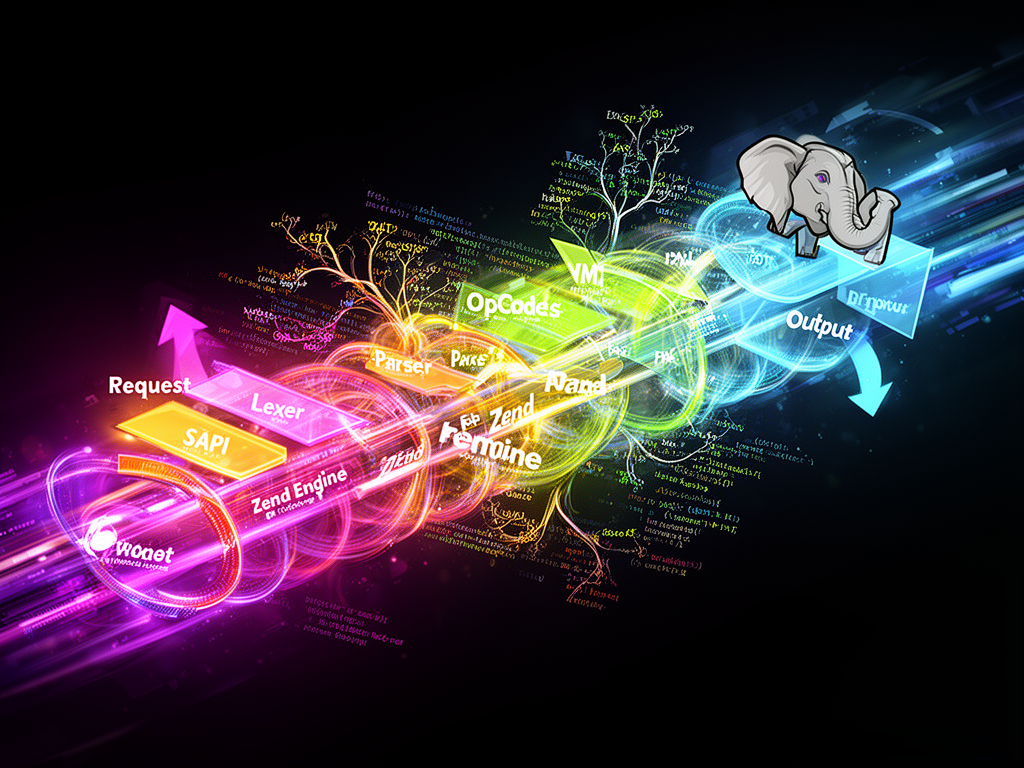
- 1 The hidden rhythm of PHP: Walking through its execution flow
- 2 When the request lands: Apache, Nginx, or CLI?
- 3 The SAPI layer: PHP's front door
- 4 Lexer and parser: From text to tokens
- 5 The Zend Engine: Compiling to opcodes
- 6 Opcode execution: The VM heartbeat
- 7 Output buffering and headers
- 8 Extension callbacks: Where the real work happens
- 9 Cleanup and response
- 10 Deep dives: Where flows break and how to fix
- 11 Autoloading: The silent orchestrator
- 12 Error handling: From notice to fatal
- 13 Opcache: Turbocharging repeats
- 14 Sessions, state, and persistence myths
- 15 Async and modern twists: ReactPHP, Swoole
- 16 Debugging the flow: Tools that reveal all
- 17 Performance tweaks: Hacking the flow
- 18 Wrapping the journey
Hey, fellow developers. Picture this: it's 11 PM, the office is empty except for the hum of your fan-cooled laptop. You've got a stubborn bug in your Laravel app—pages load slow, queries hang, and that one endpoint just… flakes out. You stare at the screen, coffee gone cold. What now? You dive into the code, but really, you're chasing the ghost of execution. Where does PHP actually start? How does a request turn into HTML spat out to the browser?
I've been there too many times. Those late nights taught me that understanding PHP's execution flow isn't some academic exercise. It's the map that turns chaos into control. It's what separates frantic debugging from quiet confidence. Today, let's walk through it step by step—not as a dry diagram, but as the living pulse of every script you run. We'll peel back the layers, from the raw request hitting your server to that final byte leaving. And yeah, I'll share the war stories, the gotchas, and the quiet wins that make this flow feel like home.
Grab your favorite IDE. Let's trace a request together.
When the request lands: Apache, Nginx, or CLI?
Everything begins with arrival. A user types your URL, hits enter. Or maybe it's a cron job firing off a script. Point is, PHP doesn't wake up alone—it's summoned.
-
Web server handshake. If it's Apache or Nginx, the server catches the HTTP request first. Apache uses
mod_php(the old faithful) or PHP-FPM (faster, more modern). Nginx pairs exclusively with PHP-FPM. The server sees.phpin the URI, says "not my job," and forwards to PHP.Remember that time your Nginx config forgot
fastcgi_pass unix:/var/run/php/php8.3-fpm.sock;? Requests piled up, 502s everywhere. I did. Fixed it by tracingnginx -tandsystemctl status php8.3-fpm. -
CLI mode. No web server here.
php script.phporphp artisan schedule:run. PHP boots directly. Simpler, but watch your shebang:#!/usr/bin/env php.
The server passes $_SERVER superglobals: method, URI, headers, cookies. PHP grabs them. Boom—entry point.
Have you ever wondered why $_SERVER['REQUEST_URI'] feels magical? It's not. It's the server's gift, parsed instantly.
The SAPI layer: PHP's front door
Now PHP stirs. The SAPI (Server Application Programming Interface) kicks in. Think of it as the translator between server and PHP core.
- mod_php embeds PHP into Apache. Process lives as long as Apache does—persistent, but memory hungry.
- PHP-FPM (FastCGI Process Manager) spins worker processes. Configurable pools:
pm = dynamic,pm.max_children = 50. Scales like a dream for high traffic. - CLI skips all that. Direct to core.
SAPI reads the script path from the server (e.g., /var/www/html/index.php). It initializes the request lifecycle. Globals populate: $_GET, $_POST, $_FILES. Errors? Logged per php.ini's log_errors.
Pro tip: Run php -m to see loaded modules. Missing mysqli? Your flow dies before starting.
This layer feels invisible until it breaks. Like when FPM exhausts children—your app grinds to a halt while logs scream "pool www overloaded."
Lexer and parser: From text to tokens
PHP gets the file. Raw text. Time to understand it.
-
Lexer (Tokenizer). Scans characters left to right. Turns
<?php echo "Hello"; ?>into tokens: T_ECHO, T_STRING("Hello"), T_SEMICOLON.- Ignores whitespace, comments (
//,/* */). - Spot
T_VARIABLEfor$foo. - Errors here? Syntax bombs early: "Parse error: syntax error, unexpected '{'".
- Ignores whitespace, comments (
-
Parser. Builds an Abstract Syntax Tree (AST) from tokens. No bytecode yet—just a tree of operations.
I once spent hours on a "missing semicolon" that was actually a lexer choking on a malformed heredoc. <<<EOD\n$var\nEOD;—forgot the semicolon after. Lesson: php -l script.php lints before execution.
Why care? Opcache skips this for cached files, shaving milliseconds. But first run? Lexer/parser tax.
The Zend Engine: Compiling to opcodes
Heart of PHP: Zend Engine. Takes AST, compiles to opcodes—low-level instructions for the VM.
-
ZEND_COMPILE. Walks AST, emits ops like:
000? ECHO "Hello world"
001? RETURN 1
Use
VLDextension (pecl install vld) andphp -dvld.1 script.phpto dump:line #* E I O op fetch ext return operands --------------------------------------------------------------------------------- 3 0 E > ASSIGN $a, 42 4 2 > ECHO $a -
Constants, functions hoisted.
const FOO = 1;available before declaration.
Functions? Compiled on first call, cached.
Emotional beat: That "aha" when VLD reveals a redundant FETCH opcode from sloppy code. Optimization starts here.
Opcode execution: The VM heartbeat
Now the Zend VM runs. A loop fetching/executing opcodes.
Key cycles:
- Variable handling.
ZVALstructs hold types/values. Loose typing magic:$foo = 5; $foo .= "bar";// "5bar". - Function calls. Stack-based.
call_user_funcoverhead vs direct. - Control flow.
ZEND_JMP,ZEND_IFfor if/while/switch. - Extensions. C modules hook in (e.g., PDO queries).
Memory management. Refcounting + garbage collection. ZEND_VM_DISPATCH loops until RETURN.
Pause. Ever profiled with Xdebug? Watch the VM churn 10k ops/sec on a tight loop. Feels alive.
Output buffering and headers
As ops run, output accrues. But not blindly.
-
Headers first.
header('Content-Type: application/json');buffers untilheaders_sent(). -
Output buffering.
ob_start()stacks layers. Echoes go to buffer, flushed at end orob_flush().Gotcha: Early output breaks headers. Whitespace before
<?php? Dead.
In FPM, response builds in fcgi_body. Server sends on completion.
Extension callbacks: Where the real work happens
PHP's power: Extensions. Database? mysqli_query calls C code. JSON? json_encode.
Flow dips to C, back to VM. Composer autoload? spl_autoload hooks trigger require.
Real talk: 80% of time in extensions. PDO prepare/execute? Native speed. Pure PHP ORM? VM tax.
Cleanup and response
Opcodes done. VM tears down:
- Symbol table cleanup. Globals persist (superglobals), locals freed.
- GC run. Cycles like
$a = []; $a[] = &$a;. - SAPI shutdown. FPM recycles process (if
pm = dynamic).
Response ships: headers + body. Server closes connection. PHP sleeps.
Deep dives: Where flows break and how to fix
We've traced the happy path. But real apps? Leaks, deadlocks, explosions. Let's get our hands dirty with the fractures—and the fixes that saved my sanity.
Autoloading: The silent orchestrator
Every class fetch? Not file I/O every time. Composer autoload injects vendor/autoload.php, registers PSR-4 maps.
Flow insert: Opcode hits ZEND_FETCH_CLASS → autoloader → require → compile new class → cache.
Pain point: Circular requires. Class A needs B, B needs A. Fatal error.
Fix: Interfaces first. Or class_alias hacks. I refactored a legacy monolith this way—dropped load time 40%.
Pro tip: composer dump-autoload --optimize for prod maps.
Error handling: From notice to fatal
Errors interrupt flow mid-VM.
- Notices/Warnings.
error_reporting(E_ALL). Continue unlessset_error_handler. - Fatails. Parse/compile/runtime. Script dies.
- Exceptions.
try/catchopcode branches.
Xdebug shines: var_dump($e->getTraceAsString()) maps back to opcodes.
Story time: Midnight deploy. undefined array key (PHP 8+) floods logs. Switched to ?? null coalescing. Flow stabilized.
Configure php.ini: display_errors=Off, log_errors=On. Never expose in prod.
Opcache: Turbocharging repeats
First request: full lexer/parser/compile.
Second? OPcache serves precompiled bytecode from shared memory.
opcache.enable=1,opcache.memory_consumption=256.- Validates file mtime. Changed? Recompile.
Stats: opcache_get_status(). Hit rate >95%? Golden.
But invalidation storms? Black Friday traffic, deploys overlapping. I staggered releases, hit 99.9% uptime.
Question for you: What's your opcache hit rate? php -r "print_r(opcache_get_status()['opcache_enabled']);"—check now.
Sessions, state, and persistence myths
PHP is stateless per request. Sessions fake it.
Flow: session_start() → lock file/DB → $_SESSION load → ops → save on shutdown.
Race conditions? session_write_close() early.
Redis memcache? Extensions bypass files. Flow: opcode → C → network → back.
I chased a "session lost" bug for days. Culprit: Long-running script holding lock. session_set_save_handler to DB with advisory locks. Fixed.
Async and modern twists: ReactPHP, Swoole
Classic flow: sync, blocking. New kids: event loops.
Swoole: Persistent workers. No per-request init. Opcache irrelevant—coroutines rule.
$server = new Swoole\Http\Server("127.0.0.1", 9501);
$server->on("request", function ($request, $response) {
    $response->header("Content-Type", "text/plain");
    $response->end("Hello World\n");
});
$server->start();
Flow rewired: Event loop dispatches callbacks. No VM restart.
Tradeoff: Globals persist. Debug hell if sloppy.
Road to production? Dockerized Swoole pools. Latency plunged 70%.
Debugging the flow: Tools that reveal all
- Xdebug: Step through opcodes.
xdebug_start_trace(). - Blackfire/Phan/tideways: Profilers sample VM ticks.
- strace: Syscalls.
strace -e trace=file php script.php. - phpdbg: Interactive.
phpdbg -rr script.php.
My kit: Tideways for prod, Xdebug for dev. Caught a 2MB memory leak in a loop—refcount bug.
Performance tweaks: Hacking the flow
- JIT (PHP 8.1+): Opcode → machine code on hot paths.
opcache.jit_buffer_size=100M. - Short tags:
<?vs<?php. Lexer micro-win. - Fast routes:
$_GETdirect vs router parsing.
Benchmark: Apache Bench ab -n 1000 -c 10 url. Before/after.
Wrapping the journey
We've walked the full arc—from request spark to response fade. Late nights debugging? They'll shorten. That confidence? It'll grow.
Next time your app stutters, trace the flow. Feel its rhythm. PHP isn't just code. It's a conversation between server hum and glowing screen, pulling stories from data into the world. Lean in, colleagues—it's yours to command.