Contents
- 1 PHP Architecture basics
- 1.1 Why PHP architecture still matters in 2026
- 1.2 Core principles: The foundation you can't skip
- 1.3 Layered architecture: Requests to responses
- 1.4 MVC: The PHP workhorse
- 1.5 Beyond MVC: Modern patterns in PHP
- 1.6 Databases and persistence strategies
- 1.7 Performance architecture: Don't guess, measure
- 1.8 Real-world PHP architectures: Lessons from the trenches
- 1.9 Testing your architecture
- 1.10 Scaling PHP architectures
- 1.11 Common pitfalls and how to dodge them
- 1.12 Tools every PHP architect needs
- 1.13 Wrapping up: Build to last
PHP Architecture basics
Hey, fellow developers. Picture this: it's 2 a.m., coffee's gone cold, and your screen glows with a tangle of PHP files. A bug's hiding somewhere in the routing, or maybe the database queries are choking under load. You rub your eyes, trace the request flow, and suddenly it clicks. That's the moment architecture saves you—not some abstract diagram, but the invisible skeleton holding your app together.
I've been there more times than I can count. PHP started as a simple scripting language for personal homepages, but damn, has it grown. Today, in 2026, with PHP 8.3 and beyond pushing attributes and fibers, architecture isn't optional. It's what turns a hobby project into a scalable beast powering sites like WordPress giants or custom Laravel empires. If you're hunting jobs on platforms like Find PHP, or hiring talent there, grasping these basics sets you apart. Let's dive in, no fluff, just the real stuff that sticks.
Why PHP architecture still matters in 2026
PHP's been around 30 years, yet it's thriving. Junior devs love it for quick entry—easy syntax, massive ecosystem. Seniors swear by it for reliability. But without solid architecture, you're building on sand.
Remember when we all laughed at PHP's "spaghetti code" rep? That was procedural messes from the 2000s. Now, frameworks like Laravel, Symfony, and even Slim enforce patterns. Architecture basics mean separation of concerns: keep your business logic away from the UI, database from the controllers. Why? Scale. Maintain. Debug without losing your mind.
Have you ever inherited a flat-file PHP app? One massive index.php handling everything? I have. Six months in, adding features felt like defusing a bomb. Good architecture flips that—modular, testable, future-proof.
Key truth: PHP's server-side nature demands thoughtful structure. Requests hit the server, PHP spins up, processes, responds. Poor design? Memory leaks, slow loads, security holes. Done right? Handles millions.
Core principles: The foundation you can't skip
Start here. These aren't buzzwords; they're battle-tested rules.
- Single Responsibility Principle (SRP): One class, one job. Your UserController shouldn't hash passwords and send emails. Split it.
- Dependency Inversion: High-level modules don't depend on low-level ones. Use interfaces. Inject dependencies, don't hardcode.
- Don't Repeat Yourself (DRY): That validation logic in five places? Extract to a trait or service.
- KISS and YAGNI: Keep it simple, you ain't gonna need it. Over-engineer now, regret later.
In PHP, this means ditching god objects. I once refactored a legacy app: 10k-line classes became 50 focused ones. Load times dropped 40%. Feels good, right?
Layered architecture: Requests to responses
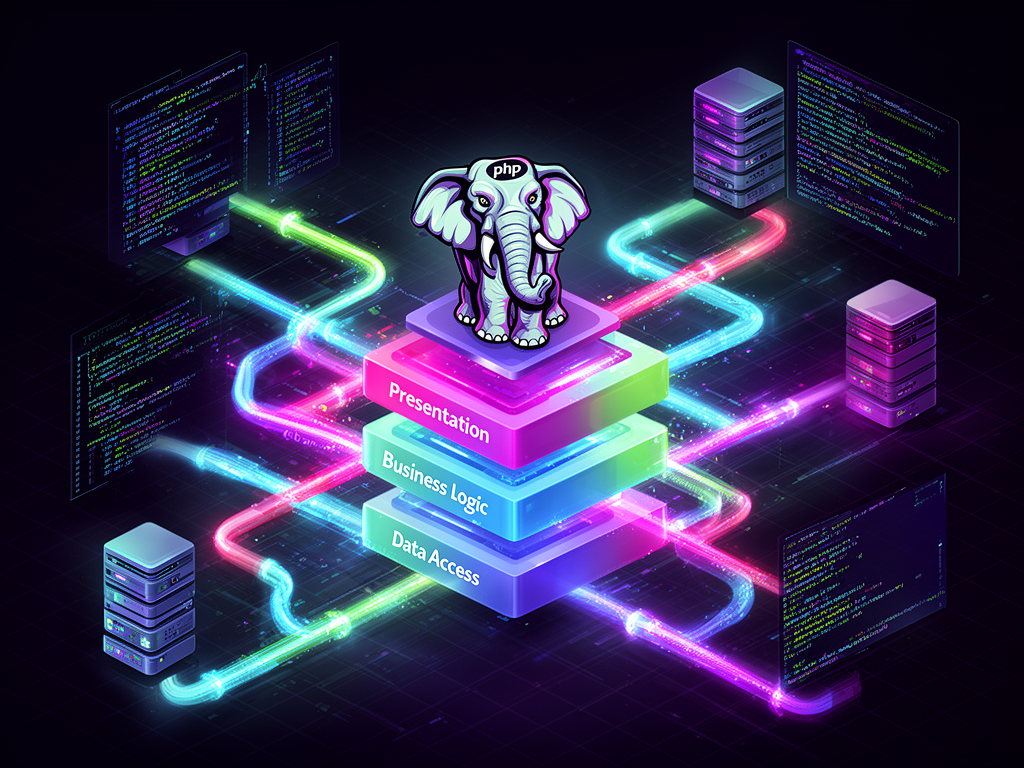
Most PHP apps follow layers. Think of it as a pipeline: HTTP request flows in, transformed, data fetched, response out.
Presentation layer
Handles user input/output. Controllers in MVC. Slim example:
$app->get('/users/{id}', function ($request, $response, $args) {
    $user = $this->userService->find($args['id']);
    return $this->view->render($response, 'user.twig', ['user' => $user]);
});
No business logic here. Just glue.
Business logic layer
The heart. Services orchestrate. UserService might validate, call repositories, apply rules.
class UserService {
    public function create(array $data): User {
        $this->validator->validate($data);
        $user = $this->userRepository->save($data);
        $this->eventDispatcher->dispatch(new UserCreated($user));
        return $user;
    }
}
Events? Decouple. One action triggers emails, logs, caches—without tight coupling.
Data access layer
Repositories abstract databases. PDO, Eloquent, Doctrine. Never query directly in controllers.
interface UserRepository {
    public function find(int $id): ?User;
    public function save(User $user): void;
}
MySQL? PostgreSQL? Swap implementations. Testable bliss.
This stack scales. Add caching (Redis), queues (RabbitMQ), APIs (GraphQL). PHP's ecosystem shines here.
MVC: The PHP workhorse
Model-View-Controller. Laravel, Symfony live it. WordPress plugins hack it.
- Models: Data + logic. Eloquent:
User::with('posts')->find(1); - Views: Twig, Blade. Templating keeps PHP out of HTML.
- Controllers: Skinny. Fat models? Debatable, but services offload.
Real talk: Pure MVC feels rigid sometimes. Hybrid with services works better for APIs. I've built RESTful backends this way—endpoints crisp, tests green.
Question for you: Ever twisted MVC for microservices? Containerize each (Docker + PHP-FPM), orchestrate with Kubernetes. PHP holds up.
Beyond MVC: Modern patterns in PHP
MVC's table stakes. Level up.
Domain-Driven Design (DDD)
For complex apps. Entities, Value Objects, Aggregates, Services. Bounded Contexts split monoliths.
In PHP, use attributes for hydration:
#[Entity]
class Order {
    public function __construct(
        public readonly OrderId $id,
        public Customer $customer,
        private array $items = []
    ) {}
}
RoadRunner or Swoole for performance. Feels enterprise, but juniors can grasp it.
CQRS and Event Sourcing
Separate reads/writes. Commands mutate, Queries fetch. Events as source of truth.
Laravel's got packages. I implemented in a e-commerce app: inventory sync flawless, scaling easy.
Microservices with PHP
Not all-in-one. API Gateway (Symfony), services in Laminas. gRPC for inter-service chatter.
Pro tip: Start monolith, split later. PHP's fine for both.
Databases and persistence strategies
PHP loves databases. MySQL default, but PostgreSQL for JSONB, Mongo for docs.
ORM vs Query Builder
Eloquent: Magic, productive. Raw queries: Control.
// Eloquent
User::where('active', 1)->paginate(20);

// DBAL
$qb->select('*')->from('users')->where('active = ?')->setParameter(0, 1);
Choose per need. Migrations: Artisan or Phinx. Seeds for tests.
Caching: Memcached, Redis. OpCache for PHP files—must-have.
Performance architecture: Don't guess, measure
Bottlenecks kill. Profile with Blackfire or Tideways.
- Autoloading: Composer PSR-4. No
includehell. - OpCache: Enables JIT in PHP 8+. 2-5x speedups.
- Async: ReactPHP, Amp. Fibers in 8.1+ for concurrency without threads.
Real scenario: App slowed at 10k users/day. Switched to queues (Laravel Horizon), sharded DB. Traffic tripled, no sweat.
Security baked in: PSR-7 for requests, OWASP top 10 covered (CSRF tokens, prepared statements).
Real-world PHP architectures: Lessons from the trenches
Let's get personal. Three years back, I led a team on a SaaS platform. Legacy procedural PHP, crashing under load. We rewrote with Symfony 6, DDD layers. Result? 99.9% uptime, team velocity up 3x.
Hiring tip for Find PHP users: Screen for architecture talk. "Walk me through a request lifecycle." Vague answers? Pass.
Case study 1: E-commerce monolith
Laravel app, 500k users.
Stack:
- Nginx + PHP-FPM 8.2
- MySQL clustered
- Redis for sessions/cache
- Horizon for jobs
Key decisions:
- Repository pattern over Eloquent for complex queries.
- API resources for frontend SPA.
- Event sourcing for order history.
Metrics: Page load <200ms, handles Black Friday spikes.
Pain point: Over-reliance on Eloquent relations N+1. Fixed with eager loading + data transformers. Wish I'd profiled sooner.
Case study 2: Microservices for fintech
Five services: Auth, Payments, Users, Notifications, Analytics.
Tech:
- Symfony per service
- RabbitMQ for events
- PostgreSQL + Elasticsearch
- RoadRunner for HTTP/queues
Challenge: Distributed transactions. Saga pattern saved us—compensating actions on failure.
Deploy: GitHub Actions to Kubernetes. PHP's container-friendly.
Lesson: Observability. ELK stack + OpenTelemetry. Logs, traces, metrics. No more "it works on my machine."
Case study 3: WordPress at scale
Not "real PHP"? Bull. Multisite with 100k pages.
Architecture tweaks:
- Custom plugins with OOP.
- Redis Object Cache.
- CDN + Varnish.
- WP-CLI automation.
Boosted from 2s to 150ms loads. Proves PHP flexibility.
Testing your architecture
No architecture without tests. PHPUnit king.
- Unit: Services, pure functions.
- Integration: DB, queues.
- Functional: API endpoints (Dusk, Codeception).
Coverage >80%. CI/CD enforces.
TDD? I do for new features. Feels slower upfront, pays forever.
Scaling PHP architectures
Vertical: Beefier servers. Horizontal: More instances, load balancers.
Cloud: AWS Lambda (Bref.sh), GCP. Serverless PHP real now.
Containers: Docker Compose dev, K8s prod.
Monitoring: New Relic, Datadog. Alerts on anomalies.
Future: PHP 9 rumors—better async? Exciting.
Common pitfalls and how to dodge them
- Anemic models: Logic in services only. Beef up models.
- Tight coupling: Interfaces everywhere.
- God services: SRP.
- Ignoring standards: PSR-12, Composer.
Debug tip: Xdebug + VS Code. Step through layers.
Tools every PHP architect needs
- IDE: PhpStorm. Refactoring god.
- CLI: Symfony Console, Laravel Artisan.
- Static analysis: PHPStan, Psalm.
- API docs: Swagger/OpenAPI.
Communities: PHPTheRightWay, Laravel News. Find PHP for jobs, resumes.
Wrapping up: Build to last
We've covered layers, patterns, real apps. Architecture isn't diagrams—it's decisions in late nights, choices that let code breathe.
Next project, sketch your layers first. Feel the difference. Your future self—and team—will thank you. There's quiet power in code that endures.