Contents
- 1 Modern php is not the punchline anymore
- 2 Php in 2026: mature, boring, and incredibly important
- 3 The uncomfortable reality: tech debt and EOL versions
- 4 What companies are really looking for in php developers
- 5 For developers: building a career in php that doesn’t feel stuck
- 6 For companies: hiring php talent in a shrinking, more selective pool
- 7 The human side: late nights, invisible victories
- 8 Php plus people: where platforms like “find php” fit in
- 9 Quiet advice for fellow php developers
Modern php is not the punchline anymore
Friends, let’s start with a simple picture.
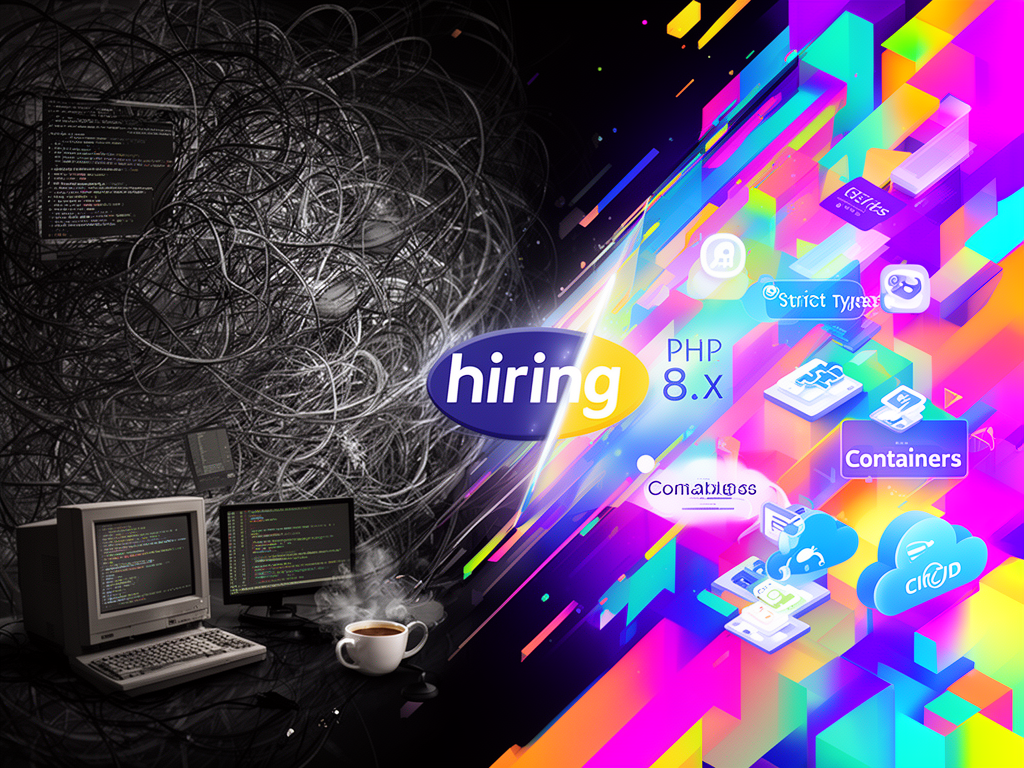
It’s late. Your office or bedroom is lit by one lonely monitor. Coffee has gone from hot to “room temperature regret.” You’ve got a legacy PHP project from 2013 open in your editor — globals everywhere, mysql_* calls, no tests, views glued to business logic like chewing gum under a desk.
And somewhere in another tab, you’ve got a job posting open: “Senior PHP developer, experience with Laravel, Symfony, Docker, CI/CD, modern PHP 8.x.”
Same language. Two different worlds.
If you work with PHP in 2026, you’re living inside that split every day. On one side: “that old project from 2012” that somehow still runs half the business. On the other: modern PHP — strict types, enums, fibers, async runtimes, CI pipelines, cloud-native deployments.
The thing is, PHP quietly powers around 70–77% of the web today.[17] It didn’t die. It matured. And now the questions are different:
- How do you stay hireable as a PHP developer in this new landscape?
- How do you hire someone who can handle both the 2012 monster and the 2026 stack?
- How do teams keep up as PHP keeps evolving, but old code refuses to disappear?
That’s exactly the world that Find PHP lives in. Let’s talk about it the way we live it: late nights, messy repos, quiet wins, and real people behind every composer.json.
Php in 2026: mature, boring, and incredibly important
The short version: PHP is still very relevant.[15]
In fact:
- It runs roughly 72–77% of websites with a detectable backend language.[17]
- WordPress alone sits on about 43% of the web.
- Modern versions (8.3, 8.4, 8.5) keep shipping performance improvements, new language features, and better security.
The PHP 8 series turned the language into something very different from what many people still imagine:
- Enums, readonly properties, typed class constants, property hooks — these are things you expect in a serious language with modern design, not the “just hack a script together” PHP stereotype.
- The new Uri extension finally replaced
parse_url()and its weird edge cases with RFC-compliant URL handling. - Fibers and newer runtimes like FrankenPHP are pushing performance and async capabilities way beyond what we thought PHP could do.
FrankenPHP alone is a nice symbol of this shift: benchmarks show around 15,000 requests/second versus about 4,000 for classic PHP-FPM — almost 4x on the same hardware, same language. That’s not “old and slow.” That’s “quietly fast.”
So when companies ask, “Is PHP still worth using for new projects?” the answers are blunt:
- For business backends, membership systems, order flows, API-first SaaS, content platforms — PHP is still a top-tier choice.[15]
- Ecosystem stability and tooling matter more than shiny hype—and PHP wins on that axis more often than not.
It’s not exciting, and that’s exactly why it works.
The uncomfortable reality: tech debt and EOL versions
Let’s talk about something that makes a lot of us wince.
According to recent maintenance reports, about 40% of PHP teams are still running end-of-life (EOL) versions. That means:
- No security patches.
- No bug fixes.
- Increased risk, especially in regulated industries.
- Extra friction when hiring, because new PHP developers don’t want to live in PHP 7.x forever.
By 2026:
- PHP 7.x is completely unsupported.
- PHP 8.1 reached end of life — no more security updates.
- PHP 8.2 is drifting through its last phase of security-only support.
- 8.3, 8.4, 8.5 are where you get full love and active updates.
Staying on 8.1 or older in 2026 has been compared to “leaving your front door unlocked in a bad neighborhood.” It’s dramatic, but not wrong.
From the outside, hiring managers see this as a risk profile:
- “Our stack: PHP 7.4, random FTP deploys, no tests.”
- Versus: “Our stack: PHP 8.3+, CI/CD, containers, static analysis, meaningful code reviews.”
Same language. Completely different vibe.
From the inside, for you as a developer, this is your career environment. It’s about:
- Whether you spend your nights patching EOL systems with duct tape.
- Or building something on top of modern PHP with a roadmap that doesn’t feel like a horror movie.
What companies are really looking for in php developers
If you read through hiring trend analyses, a few signals show up again and again.
1. Modern php versus “that old project from 2012”
Teams are increasingly splitting roles into:
- People who can salvage old systems—carefully introduce tests, untangle business logic, plan upgrades from 7.4 to 8.x.
- People who can design new systems — statically typed, framework-based, containerized, designed with architecture in mind.
And the ideal hire?
Someone who can live in both worlds:
- Reads legacy code without judgment and without panic.
- Writes new code using strict types, modern frameworks, dependency injection, testable design.
2. Framework depth, not framework bingo
You’ll see this in serious job descriptions over and over:
- “Pick one framework and go deep: usually Laravel or Symfony.”
Depth matters more than listing five frameworks on a CV. Companies want:
- A developer who really understands the lifecycle of a Laravel app.
- Or someone who knows Symfony components, config, DI container, and bundle ecosystem by heart.
If they’re hiring for a WordPress-heavy stack, they care less about being “full-stack everything” and more about “can navigate custom plugins, performance, security, and integrations without breaking the site.”
There’s a bitter truth sitting inside a quiet line from one hiring trends article:
“Testing and quality as the new social class system.”
Translated:
- Teams that invest in testing, static analysis, and code quality tend to attract better talent and keep them.
- Teams that treat tests as “optional nice-to-have” slowly drift into a world where everything is fragile and nobody really owns anything.
In practice, that means companies increasingly look for:
- Experience with PHPUnit, Pest, or both.
- Use of static analysis tools like Psalm, PHPStan.
- Comfort with code coverage, refactoring patterns, clean architecture.
Not because it’s trendy, but because it’s the difference between “we can touch this code without fear” and “we only deploy on Fridays and then we all just pray.”
4. Devops awareness and the end of the ftp era
One of the clearest patterns in PHP hiring: companies want developers who know that FTP to a live server is over.
They’re looking for people who:
- Understand Git workflows and trunk-based or GitHub/GitLab flow.
- Are at least conversant in Docker, containers, basic orchestration.
- Can operate inside CI/CD pipelines instead of dragging files into
/var/www/htmland hoping nothing breaks.
This isn’t full-time DevOps. It’s something smaller and more humane:
“Devops awareness.”
Knowing enough about how code hits production to avoid disasters, and enough about deployment environments to debug issues that only appear “out there,” not just on localhost.
5. Php plus AI, not php versus AI
There’s a lovely phrase that shows up in modern hiring discussions:
“PHP plus AI, not PHP versus AI.”
Managers aren’t hiring developers to fight AI. They’re hiring people who can:
- Integrate AI APIs into PHP backends.
- Use AI tools to accelerate refactoring, documentation, and repetitive code.
- Maintain judgment about what should and shouldn’t be automated.
The real leverage isn’t “AI replaced the developer.” It’s “the developer learned to use AI as part of the toolbox.”
In a world where fewer new developers are choosing PHP as their first language, experienced specialists who can pair domain knowledge with modern tools become harder to replace.
And that raises your value, if you grow with the ecosystem instead of standing still.
For developers: building a career in php that doesn’t feel stuck
If you’re a PHP developer reading this, maybe you’ve felt that tension:
- Part of you wonders if you should switch to Go, Rust, or Node just to feel “modern.”
- Another part of you knows that your ability to ship reliable business systems quickly has real value.
Here’s the honest, practical path forward, drawn from what we see across reports and hiring data.[17]
Live in modern php, even if your day job is legacy
You might still be stuck in PHP 7.4 at work. That’s fine. But you don’t have to be stuck there.
You can:
- Install PHP 8.3+ locally.
- Start a personal project in Laravel or Symfony using strict types.
- Play with newer features: enums, readonly, property hooks, Uri, pipe operator.
The goal isn’t to impress anyone immediately. It’s to make sure that when someone looks at your profile:
- They don’t just see “PHP developer since 2015.”
- They see “PHP developer who is actively living in the 8.x world, comfortable with the current ecosystem.”
Pick one framework and commit
From hiring trends and practical experience, this point keeps rising to the top:
- Pick one modern framework and go deep. Usually Laravel or Symfony.
Why it matters:
- It makes you easier to match to real jobs.
- It gives you a mental model for how modern applications should be structured.
- It helps you learn concepts (DI, events, queues, testing, middleware) that translate to other ecosystems too.
Better to be dangerously good with one framework than vaguely familiar with five.
Make upgrades part of your skillset, not just your pain
Upgrading PHP versions is not a chore that happens to you. It can be part of your professional identity.
The next five years of PHP are going to revolve heavily around:
- Getting off unsupported versions.
- Keeping projects on 8.3+ and beyond.
You can become the person on a team who:
- Knows how to audit a codebase for version compatibility.
- Knows how to introduce tests to create safety nets before upgrades.
- Understands how to read deprecation notices and plan phased changes.
That’s exactly the kind of experience that hiring managers and clients struggle to find, especially as older specialists retire or move on.
For companies: hiring php talent in a shrinking, more selective pool
On the other side of the screen, there’s the hiring manager, the CTO, the founder.
They’re staring at a graph that says:
- PHP is still huge on the web.[17]
- But fewer new developers are entering the ecosystem, making it harder to replace experienced specialists.
So the question becomes:
“How do we find people who can keep our PHP systems alive, secure, and evolving—without treating them as second-class citizens next to the shiny new tech?”
Platforms like Find PHP live at that exact intersection:
- Companies trying to hire reliable PHP developers.
- Developers trying to find good PHP roles that respect modern practices.
From company side, the hiring playbook is shifting:
- Look beyond “years of experience” and focus on signals of modern practice — versions used, frameworks, testing, DevOps awareness.
- Admit the reality of tech debt and fund time for upgrades; do not quietly expect “the new hire” to fix a decade of neglect alone.
- Recognize that PHP specialists who have stayed through the language’s modernization have deep intuition about web systems that’s hard to train from scratch.
There is a quiet “PHP Renaissance” happening. But it’s not loud or flashy. It’s happening in:
- Business apps that quietly keep companies running.
- APIs that serve mobile apps.
- Membership systems, CRMs, dashboards, automation scripts.
The people who can maintain and extend those systems are not “legacy devs.” They’re infrastructure for the modern web.
The human side: late nights, invisible victories
Let’s strip away the buzzwords for a moment.
Think about the last time you fixed a subtle production bug in a PHP app:
- Some bizarre
parse_url()behavior on certain inputs. - A race condition exposed only under high load.
- An outdated PHP version throwing warnings in a third-party library.
You didn’t get a press release or a conference talk out of it. You got:
- An email that stopped going out with errors.
- A dashboard that started showing the right numbers.
- A client that quietly stayed.
That’s the emotional texture of PHP work in 2026. It’s not glamorous, but it’s oddly profound.
You are:
- Negotiating with old code.
- Sneaking modern practices into legacy projects.
- Keeping systems alive long enough to upgrade them into something safer.
You’re also, more and more, doing this in an environment where:
- 40% of teams sit on EOL versions and are starting to feel real pressure to move.
- PHP keeps releasing new versions annually, with features you wish you had in those old projects.
- New runtimes show what PHP is capable of if someone cares enough to push it.
It’s a strange mix: part emergency room, part quiet craft.
Php plus people: where platforms like “find php” fit in
Platforms like Find PHP are not just job boards. They are maps.
They show:
- Where modern PHP work is happening.
- Where companies recognize the value of experienced PHP specialists.
- Where developers who’ve grown with the language can find roles that match their skillset.
For developers, this kind of ecosystem means:
- You don’t have to accept every “PHP developer = WordPress grunt + FTP deploys” stereotype.
- You can look specifically for work that mentions PHP 8.x, Laravel/Symfony, testing, DevOps, security focus.
- You can place your experience in a context where it’s understood, not treated as “stuck in the past.”
For companies, it means:
- You can find people who not only write PHP, but understand the 2026 state of the ecosystem.
- You can hire someone who knows why staying on 8.1 is a bad idea and how to move forward realistically.
- You can discover individuals who think in terms of architecture, lifecycle, maintenance, not just “features by Friday.”
Underneath all of that is a simple shared reality:
PHP is now a mature, cloud-ready backend technology with a long future.[15]
The web quietly depends on people who know how to wield it well.
Quiet advice for fellow php developers
If you’re still with me at this point, you’re probably the kind of developer who cares. So let’s keep this simple and human.
In the next few years, you’ll probably:
- Touch code written by someone who left the company eight years ago.
- Ship features into stacks that are older than some junior devs in the industry.
- Read release notes for PHP versions that your current employer won’t adopt for another year.
Amid all that, a few choices will shape your path more than anything else:
- Stay current even when your job isn’t. Install new PHP versions locally, read language change logs, practice on side projects.
- Go deep on one framework. Make it part of how you think, not just something you “use.”
- Treat testing and quality as your personal standard, not just a company policy. Write tests even when nobody asks. Use static analysis even if you have to introduce it gently.
- Understand your runtime and infrastructure. Know how your code hits production. Respect the pipeline as part of your craft.
- Remember that PHP is not dead, and neither is the work you do with it. The web still runs on what you ship.[17]
And if you’re looking for work or trying to hire, know that there is an ecosystem built around exactly those realities. Places like Find PHP exist because this language, and the people who work with it, still matter more than most people realize.
Somewhere, right now, a PHP script is processing an order, saving a membership, sending an email, logging a payment. No one sees the code. But someone wrote it, debugged it, kept it up to date, pushed it through a pipeline, and made sure it stayed alive when versions changed.
If that someone is you, I hope you feel, even for a moment, how quietly important your work has become—and how much room there still is to grow.