Contents
- 1 PHP Execution Lifecycle Explained
- 2 The First Idea: A PHP Script Is A Request Story
- 3 Where Execution Actually Begins
- 4 From Source Code To Executable Opcodes
- 5 The Runtime: Where Your Code Meets The World
- 6 Why PHP Feels Different From Long-Running Systems
- 7 Common Stages You Feel In Daily Work
- 8 Execution Limits Are Not Decorations
- 9 The Role Of PHP-FPM And The Web Server
- 10 The Quiet Importance Of Shutdown
- 11 Lifecycle Thinking Makes Better Developers
- 12 The Lifecycle And The PHP Ecosystem Today
- 13 A Simple Mental Model For Real Projects
- 14 Where Developers Usually Get Tripped Up
- 15 Why This Matters For Hiring And Team Work
- 16 The Part Most People Feel, Even If They Never Name It
PHP Execution Lifecycle Explained
Every PHP request looks simple from the outside: a browser asks, a page appears, and the server does its quiet work in between. But under that ordinary moment is a small chain of events that decides whether your app feels fast, stable, and trustworthy—or heavy, fragile, and confusing.
If you have ever stared at a blank screen at 11:40 PM with coffee gone cold beside the keyboard, the PHP execution lifecycle is the invisible machinery behind that scene. It is not just “how PHP runs.” It is the sequence that turns source code into output, one request at a time, and understanding it changes the way you read bugs, performance issues, and framework behavior.
The First Idea: A PHP Script Is A Request Story
PHP applications are traditionally request-driven: one request comes in, the script runs, output is sent, and the process ends for that request. That simplicity is the reason PHP became such a practical web language, and it is also why many developers underestimate the amount of orchestration happening beneath the surface.
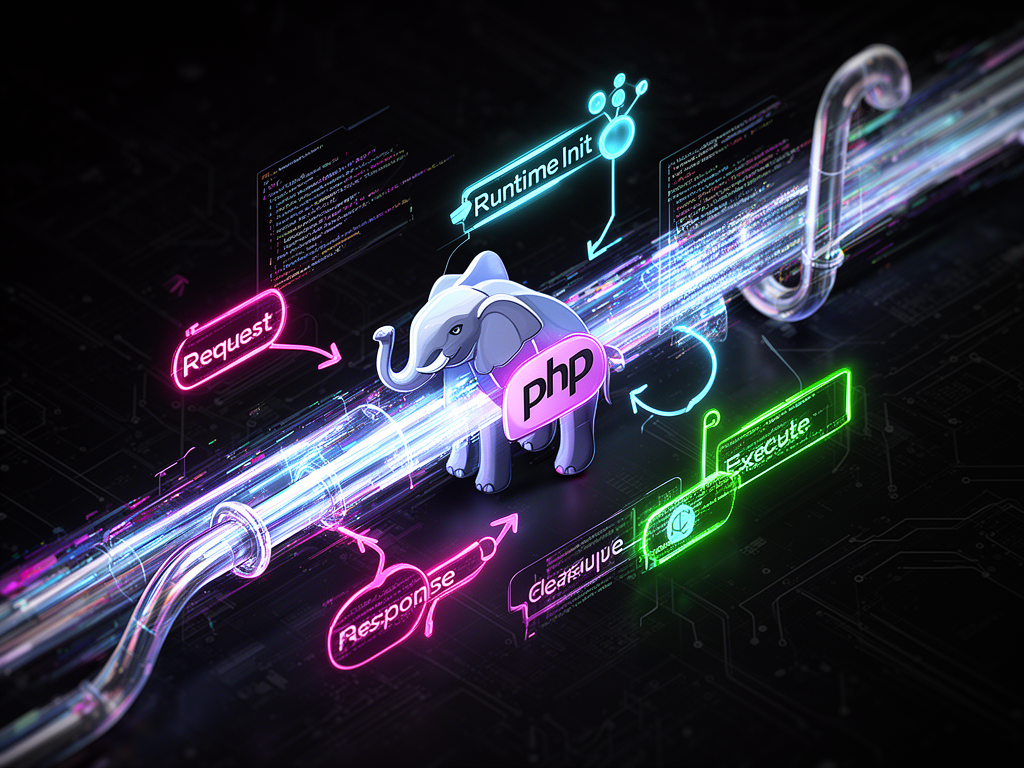
At a high level, the PHP execution lifecycle usually follows this path:
- A web server receives a request.
- The request is handed to PHP, often through PHP-FPM or another SAPI.
- PHP loads configuration and prepares the runtime.
- The script is compiled, then executed.
- Output is returned to the client.
- The runtime cleans up after the request ends.
That list looks tidy. Real life is less tidy. In production, every one of those steps can become a place where latency, memory pressure, misconfiguration, or framework overhead quietly accumulates.
Where Execution Actually Begins
The lifecycle starts before your index.php file does anything interesting. PHP first initializes its runtime, loads configuration, and sets up the environment that will govern the request. Configuration values such as max_execution_time, memory_limit, post_max_size, and upload_max_filesize can shape what the script is allowed to do and how far it can go before the engine stops it.
That matters because a lot of “application bugs” are really execution boundary problems. A file upload fails, but not because the upload form is broken. A background import dies, but not because the loop is wrong. A report generation endpoint times out, but not because the SQL query is slightly ugly. Sometimes the script is simply pushing against the limits PHP has been told to enforce.
From Source Code To Executable Opcodes
Once PHP has prepared the runtime, it reads your script and turns it into something the engine can execute. In practical terms, the file is parsed, compiled, and prepared for execution by the interpreter. This is the point where syntax errors surface early, before the request can move forward.
For many developers, this stage is invisible because frameworks abstract it away. Yet it is still there, and it explains a lot about the difference between a small syntax mistake and a runtime exception. A broken brace stops the story immediately. A bad database value waits until the code path reaches it. Two different failures. Two different moments in the lifecycle.
If you have ever wondered why a clean deployment can still fail in production after passing local tests, this is one reason: the execution lifecycle only reveals issues when the relevant code path is actually hit. Some bugs are asleep until traffic wakes them up.
The Runtime: Where Your Code Meets The World
After compilation, PHP executes the script step by step. This is the moment most developers think of as “running PHP,” but it is really the heart of the execution lifecycle: variable assignment, function calls, class loading, database queries, template rendering, API calls, exception handling, and response generation all happen here.
In a modern app, the script is rarely just a script. It is a web of dependencies. Autoloaders wake up classes when needed. Middleware filters requests. ORMs negotiate with databases. Containers assemble services. The request may begin with one line in public/index.php, but by the time it finishes, it may have touched dozens of objects and several network boundaries.
That is why performance tuning in PHP is often less about “making PHP faster” and more about reducing what happens during each request. Fewer queries. Less file I/O. Less repeated object construction. Smaller payloads. Smarter caching. The lifecycle is short, but the cost inside that short window can still be significant.
Why PHP Feels Different From Long-Running Systems
PHP’s traditional request-per-request model has a particular elegance. The process starts fresh, does its job, and disappears. That design makes memory leaks less painful than in long-running daemons, because the request ends and the runtime is cleaned up afterward.
But that same design can make developers careless. It is easy to think, “The process will die anyway,” and ignore waste inside a request. Yet waste still matters when traffic arrives in bursts. A single endpoint with expensive execution steps can become a traffic amplifier, multiplying cost across hundreds or thousands of requests per minute.
Have you ever profiled an endpoint that looked harmless and discovered it was quietly doing three expensive things on every visit? That is the lifecycle talking back.
Common Stages You Feel In Daily Work
Even if you never draw the lifecycle on a whiteboard, you feel it every day:
- Bootstrap: configuration loads, autoloading starts, framework services are prepared.
- Request handling: route matching, controller selection, middleware execution.
- Business logic: validation, calculations, database access, external API calls.
- Response building: HTML, JSON, redirects, headers, cookies.
- Shutdown: cleanup, logging, session write, memory release.
These stages are often blurred together in code, but they are not the same thing. A slow bootstrap hurts every request. A slow database query hurts specific routes. A noisy shutdown can make logs harder to trust. A session lock can make concurrent requests feel strangely frozen. The lifecycle gives each issue a place to live.
Execution Limits Are Not Decorations
PHP configuration is not just operational housekeeping. It is part of the execution lifecycle itself. Settings like max_execution_time exist to stop poorly behaved scripts from monopolizing resources, while memory-related limits help prevent runaway requests from exhausting the server.
That sounds technical, but the emotional version is simple: limits protect the rest of the system from one bad moment. One import gone wrong should not freeze the whole app. One malformed upload should not bring the machine to its knees. One loop should not be allowed to spin forever while users wait in silence.
And yes, when you see a timeout in production, it is frustrating. But it is also a clue. It tells you where the lifecycle is being stressed.
The Role Of PHP-FPM And The Web Server
In modern setups, PHP often runs behind PHP-FPM, with the web server forwarding requests into worker processes. That means the lifecycle is not only about PHP code; it is also about how requests are queued, assigned, executed, and released by the process manager. When workers are saturated, requests wait. When workers are misconfigured, throughput falls. When timeouts are mismatched, the browser gives up before PHP finishes.
This is where the execution lifecycle becomes operational, not academic. A developer who understands request flow can ask better questions:
- Is the slowness in PHP code, or in queueing?
- Is the worker busy, or is the database slow?
- Is the request timing out because of app logic, or because of upstream limits?
- Is this endpoint CPU-bound, I/O-bound, or blocked on locks?
Those questions save hours. Sometimes days.
The Quiet Importance Of Shutdown
The end of a request is easy to ignore because it rarely gets celebrated. The response is sent, the page renders, the API call succeeds, and everyone moves on. But shutdown matters. Logs are flushed. Sessions may be written. Temporary structures are released. Cleanup happens.
In everyday development, the end of the lifecycle often explains the “ghost” problems—the kind that appear only under load or only after a certain route has been hit many times. A script might technically finish, but not before leaving behind cost that adds up over time.
There is something almost human about that. We remember the visible work and forget the cleanup, yet both are part of the job.
Lifecycle Thinking Makes Better Developers
The real value of understanding PHP execution is not memorizing engine internals. It is learning to think in request boundaries. Once you do that, you start seeing your application differently:
- You stop treating every slowdown as a generic PHP problem.
- You begin separating startup cost from runtime cost.
- You pay attention to what happens before and after the main logic.
- You understand why tiny inefficiencies become expensive under load.
- You debug with a timeline instead of a hunch.
That shift is subtle, but it changes your day-to-day work. The code feels less magical and more honest. The system starts showing its seams.
The Lifecycle And The PHP Ecosystem Today
PHP itself also has a lifecycle as a platform, separate from request execution. Releases now follow a structured cadence: feature releases happen annually, maintenance releases arrive every four weeks, and feature versions receive two years of active support plus an additional year of security support.
That matters because the execution lifecycle of your app does not exist in a vacuum. It lives inside a language ecosystem that changes over time. Framework behavior shifts. Engine performance evolves. Security fixes arrive. Old versions age out. If you build or hire in the PHP world, version awareness is not optional; it is part of keeping the execution path stable and safe.
For teams browsing jobs, hiring PHP developers, or keeping up with ecosystem news, this is the practical reality behind the headline of “PHP is stable.” Stability is not stasis. It is a maintained discipline.
A Simple Mental Model For Real Projects
When I explain the execution lifecycle to people on a team, I like to keep it brutally simple:
- Request enters: the server hands work to PHP.
- PHP prepares: configuration and runtime are loaded.
- Code compiles: the script is parsed into something executable.
- Logic runs: your app does its work.
- Response leaves: output goes back to the client.
- Cleanup happens: resources are released.
If you keep that model in your head, debugging gets easier. You begin asking where the pain lives in the chain. Is the problem before code execution, during execution, or after output? That one question can cut through a lot of noise.
Where Developers Usually Get Tripped Up
Most mistakes around the PHP execution lifecycle come from confusing layers. A few examples:
- A slow page is blamed on PHP when the database is the real bottleneck.
- A memory error is blamed on the framework when the payload size is the real issue.
- A timeout is blamed on the server when the script is actually blocked on an external API.
- A deployment failure is blamed on code when the runtime version changed underneath it.
The lifecycle helps separate those layers. That separation is one of the most underrated skills in backend work. It turns guesswork into diagnosis.
Why This Matters For Hiring And Team Work
For recruiters and hiring managers, understanding the execution lifecycle is a fast way to tell who has actually shipped systems and who has only written code in isolation. A solid PHP developer can talk about request flow, worker behavior, configuration limits, error handling, and version compatibility without drifting into vague slogans.
For developers looking at roles on platforms like Find PHP, this knowledge also becomes part of your professional language. It gives you a way to describe what you did beyond “I built an endpoint.” You can say you reduced request time by moving work out of the critical path, or that you stabilized uploads by aligning PHP limits with application needs, or that you improved throughput by tuning the request lifecycle instead of adding hardware blindly. That is the difference between code that exists and systems that breathe.
The Part Most People Feel, Even If They Never Name It
The execution lifecycle is technical, but its meaning is strangely human. A request arrives with a problem. The system does its work. A response comes back. Then everything resets and waits for the next call. It is a tiny ritual repeated all day, thousands of times, in silence.
That rhythm is part of why backend work can feel calm one moment and deeply exposed the next. When it goes well, nobody notices. When it breaks, everyone notices. And in between those two states lies the craft: reading the lifecycle, respecting its limits, and learning where the pressure hides.
The good news is that once you understand the sequence, the system stops feeling like a black box and starts feeling like something you can actually listen to.