Contents
- 1 Why php outsourcing models matter more than we admit
- 2 The three core models of php outsourcing
- 3 Freelancers: fast, flexible, and fragile
- 4 Outstaffing: more hands, same steering wheel
- 5 Full project outsourcing: “we’ll build it for you”
- 6 Onshore, nearshore, offshore: same models, different distances
- 7 Matching models to real php scenarios
- 8 How to choose your model without guessing
- 9 What developers quietly think about outsourcing
- 10 Building trust in a distributed php world
Why php outsourcing models matter more than we admit
There’s a specific kind of moment most of us know.
It’s 22:47.
The office is dark except for your monitor and that one emergency light in the hallway that always flickers like it’s about to give up.
Product wants features. Sales wants demos. Finance wants lower costs. You, somehow, are supposed to deliver a fully working PHP module in three weeks with a team that’s already overloaded.
Someone says the magic word: “Outsourcing.”
And suddenly everything gets blurry.
- “Should we hire freelancers?”
- “What about an agency?”
- “What’s the difference between outstaffing and outsourcing again?”
- “Can we trust a remote team with our core product?”
This is where a lot of teams quietly make their most expensive mistake—not in code, not in architecture, but in how they bring people into the work.
Especially in PHP, where the ecosystem is huge and mature, and there are thousands of people ready to jump in, the outsourcing model you pick can either give you leverage… or quietly sabotage you for years.
So let’s slow down, grab a coffee (or whatever gets you through those late sprints), and walk through the main PHP outsourcing models in a way that’s honest, practical, and grounded in real situations.
Not textbook stuff.
The kind where someone says: “We’ve been there. Here’s what actually happened.”
And yes—this is for you if you’re:
- Trying to hire PHP developers from the outside.
- Looking for PHP jobs and trying to understand what “outsourcing” means for you as a developer.
- Or just trying to make sense of this whole “remote, distributed, outsourced, nearshore, offshore” soup.
Let’s untangle it.
The three core models of php outsourcing
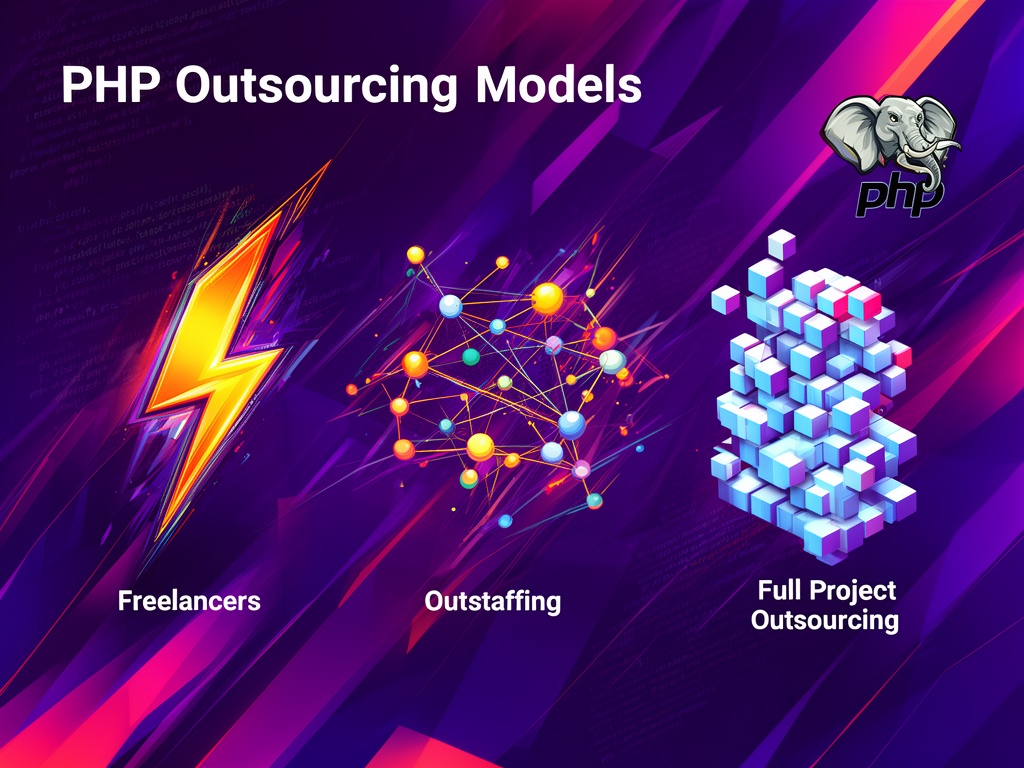
There are many fancy terms, but for most real-world PHP projects, it boils down to three main models:
- Freelancers
- Outstaffing (dedicated developers / staff augmentation)
- Full project outsourcing (agency / vendor)
They can be mixed, sure, but the core questions stay the same:
- Who manages the people?
- Who owns the decisions?
- Who takes responsibility when things go wrong?
Let’s go through them one by one.
Freelancers: fast, flexible, and fragile
Imagine this:
You have a core team, but they’re fully booked. You need:
- A small Laravel admin panel.
- An API integration with some finicky third-party service.
- A WordPress plugin for a marketing campaign.
You don’t want to hire full-time for this. So you jump to Upwork, a job board, or a platform like Find PHP, and you look for freelance PHP developers.
It feels simple: post a job, pick someone, get it done.
Freelancers shine when:
- The task or project is clearly defined.
- The scope is limited and not mission-critical.
- You’re okay with individual ownership, not team integration.
- You want speed and low overhead.
You get:
- Lower cost than hiring full-time.
- No long-term commitment.
- The ability to test out people before deeper collaboration.
But here’s the part people underestimate.
With freelancers:
- You manage priorities.
- You keep context in your head.
- You become responsible for quality, communication, and integration.
You’re effectively expanding your TODO list, not delegating it.
You’ll find yourself:
- Reviewing PRs at midnight.
- Writing long specification docs so things don’t go sideways.
- Trying to sync a freelancer in a different time zone with your core team.
When does freelance PHP work break down?
- When the project grows from “a small feature” to “an ongoing system.”
- When different freelancers touch the same part of the codebase at different times.
- When you need reliability, not just availability.
In other words: freelancers are tools, not teams.
If you’re a CTO, tech lead, or founder, ask yourself:
“Do I want to expand my workload or transfer part of it?”
If it’s the latter, you’re not looking for freelancers. You’re looking for a team model.
Outstaffing: more hands, same steering wheel
Now let’s move to something subtle but powerful: outstaffing.
Outstaffing is often called:
- Dedicated PHP developers
- Staff augmentation
- Remote PHP team extension
The idea is simple:
A company (or platform like Find PHP that connects people) gives you developers who join your team, but they’re officially employed elsewhere.
They work on:
- Your repositories
- Your tasks
- Your Slack/Jira/Notion
They show up to your standups.
They follow your code style, use your branching strategy, stick to your architecture decisions.
You gain capacity without taking on full HR overhead.
It feels like this:
You start a morning standup.
Three people are in the office, two join from home, and one joins from another country. They’re all just… part of the same dev team.
What you still own:
- Product decisions.
- Technical direction.
- Task breakdown, prioritization, releases.
In this model, your company remains the brain. The outstaffed developers are additional muscle and skill.
Outstaffing works beautifully when:
- You already have a technical lead or CTO.
- You know what to build and have some processes.
- You want to scale up or down gradually.
- You care deeply about code consistency and long-term ownership.
You can:
- Start with 1–2 PHP devs.
- Grow to 5–7 if the product scales.
- Reduce back when the peak passes.
You keep the knowledge inside the team, not scattered across one-off freelancers.
The main risks:
- If your internal management is weak, outstaffing won’t save you.
- If tasks are fuzzy and priorities change daily, everyone will feel lost.
- If you treat “remote” as “less important,” those devs will drift.
Outstaffing is not a magic wand.
It’s an amplifier.
If your culture is healthy and your processes make sense, external developers can plug in and become real teammates.
If not, they’ll just be experienced strangers writing code for unclear goals.
Full project outsourcing: “we’ll build it for you”
Then there’s full project outsourcing.
This is the model where you say:
“Here’s what we need. Here’s the budget. Here’s the deadline. You, external vendor, are responsible for delivery.”
You usually:
- Sign a contract with a PHP development company.
- Agree on scope, milestones, timelines.
- Have regular syncs and demos, but the vendor owns execution.
In other words, you outsource not just people, but:
- Planning
- Architecture
- Risk management
- Quality control
It feels more like working with a product partner than just a talent provider.
This can be powerful when:
- You don’t have a tech team yet.
- You’re launching an MVP in PHP: a marketplace, SaaS, CRM, internal tool.
- Your internal people are busy, but you need a major project delivered.
You get:
- A pre-built PHP team: devs, QA, sometimes DevOps and UX.
- Processes that (hopefully) are already battle-tested.
- A single point of responsibility: if it fails, the vendor doesn’t get to shrug it off.
But you also lose:
- Some control over daily decisions.
- Direct visibility into every implementation detail.
- A bit of that messy, real-time feel of in-house development.
The big questions with full outsourcing:
- Who owns the architecture decisions?
- Who documents the system in a way that future you can understand?
- What happens when the contract ends?
Because eventually:
- You’ll need in-house or outstaffed developers to maintain it.
- Or you’ll continue paying the same vendor for ongoing development.
Bad outsourcing feels like this:
You get a shiny demo. Everything looks smooth.
Six months later, your internal team opens the codebase and just stares at the directory tree thinking:
“What… what happened here?”
Good outsourcing, in contrast, feels like:
- The vendor cares about your long-term success.
- The stack is standard and maintainable (Laravel, Symfony, WordPress, reasonable custom code).
- The CI/CD, tests, configs, env files, and docs all tell a coherent story.
Full project outsourcing is trust, formalized in a contract.
The contract matters. But the relationship is what really determines the outcome.
Onshore, nearshore, offshore: same models, different distances
Overlayed on top of those models, there’s the geography question:
- Onshore – same country.
- Nearshore – nearby countries, similar time zones.
- Offshore – further away, big time differences.
No model is automatically better.
Onshore:
- Easier communication.
- Shared culture and legal framework.
- Higher rates.
Nearshore:
- Overlapping working hours.
- Often a sweet spot between budget and convenience.
Offshore:
- Bigger talent pool, lower cost.
- Requires stronger communication practices.
- Time zones can be both a curse and a hidden advantage (24/7 progress, if managed well).
What matters most:
- How comfortable are you with async communication?
- Is your team ready to document decisions instead of relying on hallway conversations?
- Are your processes ready for a distributed world?
Because if all decisions live in spontaneous office chats, any remote model will suffer, no matter how cheap or expensive it is.
And this is where platforms like Find PHP become more than “just a directory.”
They let you see who you might work with, what they’ve done, what tech stacks they’re fluent in—so the distance between “we need help” and “we’re working with the right PHP developers” gets a little shorter and less risky.
Matching models to real php scenarios
Let’s make it less abstract.
Imagine a few very common situations.
Scenario 1: the “we just need a small thing” feature
Your marketing team comes in with a request:
- “Can we add a landing page with dynamic content managed from admin?”
- “Can we integrate this payment provider that doesn’t have a Laravel package yet?”
- “We need a PHP script that migrates data from System A to System B.”
Your core team is buried under product roadmap items.
Here, a freelancer can absolutely shine.
The model:
- You define a clear task.
- You pick someone with strong PHP experience.
- You review the work, run tests, merge, done.
If the work touches your core codebase, you may still prefer a single freelancer repeatedly or someone found through a more curated platform like Find PHP, where consistency and reputation matter more than anonymous one-off gigs.
The takeaway:
- Simple, isolated, low-risk = freelance is fine.
- Complex, long-term, foundational = time to think bigger.
Scenario 2: the growing product and stressed core team
You’ve got:
- A product built in PHP (Laravel, Symfony, or even legacy mixed with modern).
- A handful of core developers.
- Pressure to ship more, faster: new modules, refactors, integrations.
You don’t want to rebuild your whole team, but you feel the strain.
This is where outstaffing fits like a glove.
You:
- Keep your existing tech lead or senior dev as the anchor.
- Add 1–3 outstaffed PHP developers.
- Plug them into your work: your Git, your Slack, your sprint cadence.
They work on:
- New features.
- Refactoring old modules.
- Stabilizing tests.
- Building internal tools.
They slowly gain context. After a while, they know the system almost as well as your in-house devs.
You haven’t outsourced your product.
You’ve just made your team bigger without fighting for local hiring for months.
This model keeps:
- Architectural control close.
- Product knowledge concentrated.
- Risk manageable.
In a place like Find PHP, you’d look for:
- People or companies that offer long-term collaboration.
- Proven experience in your frameworks.
- Clear communication styles and expectations.
Because with outstaffing, you’re picking people, not just services.
Scenario 3: the non-technical founder with a php idea
Someone wants to build:
- A SaaS app for a niche market.
- A custom CRM or dashboard to replace spreadsheet chaos.
- An internal tool that stitches together multiple systems via PHP APIs.
They have:
- A vision.
- Some budget.
- No in-house developers.
For them, jumping straight into outstaffing is tricky. Who will lead tech? Who will make architecture decisions?
In this case, full project outsourcing to a competent PHP agency can be the better first step.
You engage with a team that can:
- Validate the idea.
- Propose an architecture (for example, Laravel backend + Vue or React frontend, or just a clean PHP backend + classic server-rendered views).
- Deliver a working MVP in stages.
Later, they might:
- Help you hire or bring in outstaffed PHP devs.
- Gradually transfer knowledge, repos, documentation to your own team.
The critical piece here:
You’re not just buying code. You’re buying judgment.
Which is why picking the right vendor is less about the logo and more about the questions they ask you before they write a single line of PHP.
Weak vendors promise:
“We’ll build whatever you say.”
Stronger vendors ask:
- “Why that feature?”
- “What’s your timeline and risk tolerance?”
- “Who will maintain this after launch?”
- “Are you okay with us using framework X and tool Y for the long term?”
One feels like an order form.
The other feels like a partner.
How to choose your model without guessing
You don’t have infinite time or patience. You need a way to decide fast, but not blindly.
Here’s a simple mental checklist.
Ask yourself:
-
Do we have internal tech leadership?
- Yes → Outstaffing or freelancers can work.
- No → Stronger case for full outsourcing initially.
-
Is the work ongoing or one-off?
- One-off, isolated → Freelancers.
- Ongoing product, continuous updates → Outstaffing or full outsourcing.
-
Is this core to our business or peripheral?
- Peripheral (scripts, small tools, one-time jobs) → Freelance or small outstaffed engagement.
- Core product, critical systems → Outstaffing or full outsourcing with a trusted partner.
-
Do we want to own the direction or delegate it?
- Own it → Outstaffing.
- Delegate planning and execution → Full project outsourcing.
Then overlay geography:
- Need daily overlap and close collaboration? Onshore or nearshore.
- Comfortable with async, want access to a wider PHP talent pool? Offshore or mixed.
It doesn’t have to be pure.
Real teams often blend models:
- A core in-house team.
- Outstaffed PHP devs embedded in that team.
- Occasionally, a freelancer for a special integration.
- Maybe a specialized vendor for security audits or performance reviews.
You’re allowed to mix.
You’re allowed to evolve your model as the project matures.
What developers quietly think about outsourcing
There’s another side to this story: the developers themselves.
On platforms like Find PHP, you’ll see:
- Senior PHP developers looking for meaningful, long-term projects.
- Mid-level devs wanting to grow inside a stable product.
- Freelancers who like jumping between different challenges.
From the developer’s perspective, the outsourcing model changes everything.
Freelance often means:
- Autonomy, variety, higher risk.
- Constant context switching.
- Negotiating each contract, worrying about next month’s income.
Outstaffing often feels like:
- Being part of a team.
- Having stable income, rhythm, long-term code ownership.
- Still working with different clients over years, but not in a chaotic way.
Full outsourcing agency work can feel like:
- Jumping between projects, but within a shared culture and stack.
- Having leads and architects to learn from.
- Being sheltered somewhat from client chaos by the agency’s processes.
When a company chooses a model thoughtfully, it doesn’t only impact budget or deadlines. It shapes the daily reality of real people writing PHP somewhere:
- In a small apartment kitchen with a laptop and a cup of black coffee.
- In a coworking space with headphones on, looking at a Trello board.
- In a quiet office at the edge of a city, monitors glowing in the evening.
You’re not just choosing “outsourcing.”
You’re choosing how someone will spend their working life with you.
That choice echoes, quietly, in code quality, in attention to detail, in how much people care about your product when they close their laptop at night.
Building trust in a distributed php world
Underneath all the models, contracts, frameworks, and buzzwords, PHP outsourcing comes down to one painfully simple thing:
Trust.
- Trust that someone else will care about your system.
- Trust that your decisions will be respected.
- Trust that when something breaks, nobody disappears.
Trust doesn’t come from:
- Hourly rate.
- Fancy logo.
- Over-designed pitch decks.
It comes from small, repeatable signals:
- A developer who says “I don’t know yet, but I’ll find out.”
- A vendor who documents more than you asked for.
- A team that sends you not just code, but reasoning: “We chose this approach because…”
Whether you go with freelancers, outstaffing, or full outsourcing, the healthiest relationships usually:
- Start with something small but real.
- Grow as both sides show reliability.
- Gradually move from “us vs them” to “we.”
And maybe that’s the quiet beauty in all this.
Behind the contracts, there are people:
- Someone debugging a strange race condition in a PHP queue worker at 1 AM.
- Someone writing a migration script to move your old MySQL data safely.
- Someone carefully refactoring that terrifying 800-line controller into smaller, testable pieces.
Somewhere in the world, your future teammate is already doing that kind of work for someone else.
You haven’t met them yet.
You might meet them through a platform like Find PHP.
You might bring them in as a freelancer, as an outstaffed developer, or as part of a full outsourcing team.
The model you choose will shape how you meet, how you collaborate, and how much of yourselves you both bring into the shared work.
Pick with care.
Not in fear, not in haste—just with the quiet sense that the way we structure our teams is also the way we shape our days, our code, and, in a small but real way, our lives.