Contents
- 1 The Quiet Power Of The Transactional Outbox In PHP
- 2 The Dual-Write Problem, Or Why Your Events Go Missing
- 3 The Core Idea: Put Your Messages In The Same Place As Your Data
- 4 What The Outbox Table Actually Looks Like
- 5 The PHP Flow: One Transaction, Two Writes, Zero Inconsistency
- 6 Delivery Semantics: At-Least-Once, Not Exactly-Once
- 7 What This Looks Like In Real PHP Projects
- 8 Implementation Patterns In PHP Ecosystems
- 9 Subtle Design Decisions That Matter
- 10 Outbox Vs Event Sourcing: Different Tools, Different Lives
- 11 Why This Pattern Matters For PHP Developers, Not Just Architects
- 12 From Code To People: The Emotional Side Of Reliability
- 13 A Practical Way To Introduce Outbox Into Your PHP System
- 14 The Kind Of Code That Lets You Sleep
The Quiet Power Of The Transactional Outbox In PHP
There’s a particular kind of silence you only hear when production breaks.
The logs stop. The queue looks strangely empty. Your database says “order_created = 1”, but Kafka swears those events never existed. Somewhere between “INSERT INTO orders…” and “publish to broker…”, reality split in two.
If you’ve ever stared at that kind of inconsistency at 2 AM, you already understand why the Transactional Outbox Pattern exists, even if you haven’t named it yet.
Friends, let’s talk about that gap.
Because in modern PHP systems, that gap is where most of our hardest bugs live.
The Dual-Write Problem, Or Why Your Events Go Missing
Imagine a very standard PHP microservice:
- You receive “CreateOrder” from the frontend.
- You write the order into MySQL or PostgreSQL.
- You publish
order.createdto RabbitMQ, Kafka, Redis Streams, or even just a webhook.
Two separate systems. Two separate writes.
If you’re using something like Laravel, Symfony, or a home-grown stack, the code probably looks like this in spirit:
$connection->beginTransaction();

try {
    $orderId = $orderRepository->create($payload);

    $eventBus->publish(new OrderCreatedEvent($orderId));

    $connection->commit();
} catch (\Throwable $e) {
    $connection->rollBack();
    throw $e;
}
Looks fine… until the network decides to remind you who’s in charge.
- The database commit succeeds.
- The queue publish fails.
- You roll back? Too late. The DB has already committed.
- Now you have an order with no
order.createdevent ever reaching downstream services.
Classic dual-write problem: one operation spans two systems (database + message broker), and there is no truly atomic way to do both at once.
Most PHP systems today — event-driven APIs, CQRS setups, microservices — live right inside that problem space. Outbox exists for exactly this reason.
The Core Idea: Put Your Messages In The Same Place As Your Data
The Transactional Outbox Pattern says something deceptively simple:
“Stop trying to atomically write to two systems.
Write everything into one system first — your database — and let a separate process do the rest.”
Instead of:
- write to
orderstable - publish event to Kafka
You do:
- write to
orderstable - write event into outbox table in the same transaction
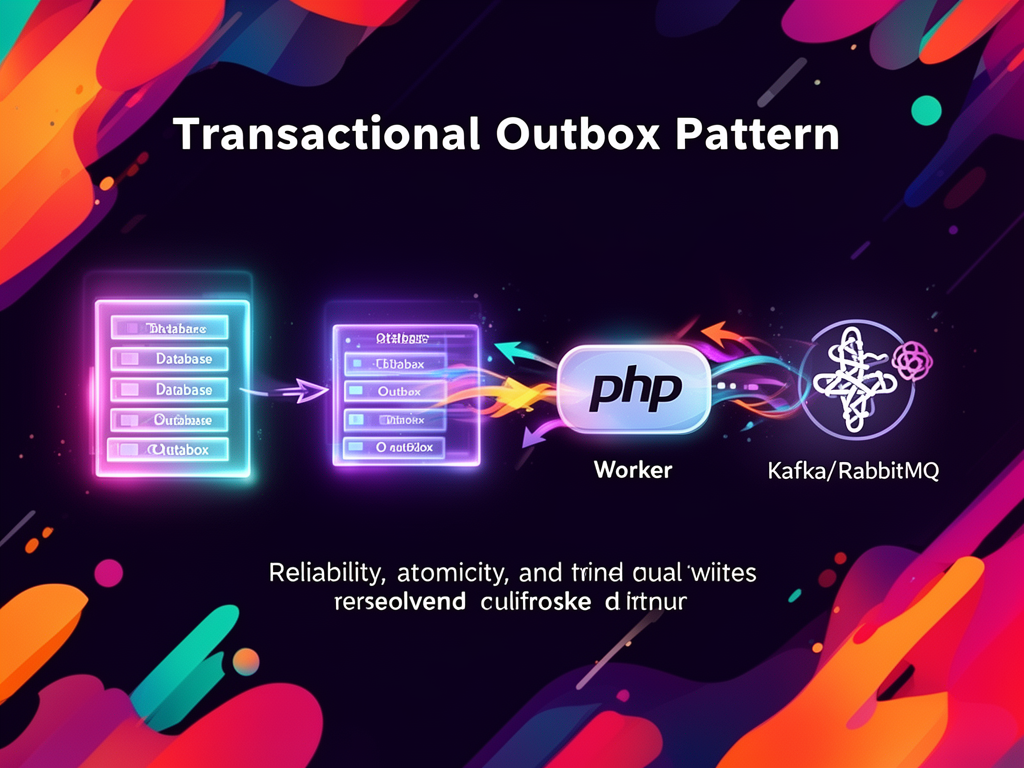
- later, a worker drains the outbox table and publishes to Kafka/RabbitMQ/etc
One transaction. One system. Your database guarantees atomicity. You stop playing distributed Russian roulette.
In PHP terms, you’re just adding another row insert to the same transaction that writes your business data. The “event” is now data in a table, not a fire-and-forget call over the network.
What The Outbox Table Actually Looks Like
Let’s get concrete.
A minimal outbox table in a relational database might look like this:
CREATE TABLE outbox_events (
    id BIGINT UNSIGNED AUTO_INCREMENT PRIMARY KEY,
    aggregate_type VARCHAR(255) NOT NULL,
    aggregate_id VARCHAR(255) NOT NULL,
    event_type VARCHAR(255) NOT NULL,
    payload JSON NOT NULL,
    created_at DATETIME NOT NULL,
    dispatched_at DATETIME NULL,
    attempts INT NOT NULL DEFAULT 0,
    last_error TEXT NULL
) ENGINE=InnoDB;
Key points:
- payload — the event data you want to send downstream (JSON, text, whatever you like).
- dispatched_at —
NULLmeans “still waiting to be sent”. - attempts and last_error — give you visibility and safety when things go wrong.
The outbox isn’t magical. It’s just a table. But it sits in the same database as your business entities, and that makes all the difference.
The PHP Flow: One Transaction, Two Writes, Zero Inconsistency
Let’s sketch a realistic PHP example. Framework-agnostic, but easy to imagine inside Symfony, Laravel, Laminas, or a custom stack.
1. When You Handle The Command Or Use Case
Your application service (or use case, if you like Clean Architecture) might do something like this:
function createOrder(CreateOrderRequest $request): void
{
    $connection = $this->db->getConnection();
    $connection->beginTransaction();

    try {
        $order = Order::create($request->customerId, $request->items);

        $this->orders->save($order);

        $event = new OrderCreatedEvent(
            $order->getId(),
            $order->getTotal(),
            $order->getCustomerId()
        );

        $this->outbox->store($event, 'orders', $order->getId());

        $connection->commit();
    } catch (\Throwable $e) {
        $connection->rollBack();
        throw $e;
    }
}
And your OutboxRepository might be something as straightforward as:
public function store(
    DomainEvent $event,
    string $aggregateType,
    string $aggregateId
): void {
    $this->connection->insert('outbox_events', [
        'aggregate_type' => $aggregateType,
        'aggregate_id'   => $aggregateId,
        'event_type'     => get_class($event),
        'payload'        => json_encode($event->toArray(), JSON_THROW_ON_ERROR),
        'created_at'     => (new \DateTimeImmutable())->format('Y-m-d H:i:s'),
    ]);
}
No queues here. No Kafka clients. No network calls. Just two inserts in the same transaction.
Either both are committed, or neither is.
That’s the heart of the transactional outbox.
2. A Separate Worker Drains The Outbox
Now you add a background process — a CLI command, a daemon, a queue worker, a supervisor-managed script — that does roughly:
- Fetch undelivered events from
outbox_events. - Mark a batch as “locked” (using
SELECT … FOR UPDATE SKIP LOCKEDif your DB supports it). - For each event:
- Publish to broker/webhook.
- On success, set
dispatched_at = NOW(). - On failure, increment
attempts, setlast_error.
Something like:
public function processBatch(int $limit = 100): int
{
    $connection = $this->db->getConnection();

    $events = $connection->fetchAllAssociative(
        'SELECT *
         FROM outbox_events
         WHERE dispatched_at IS NULL
         ORDER BY id
         LIMIT :limit
         FOR UPDATE SKIP LOCKED',
        ['limit' => $limit],
        ['limit' => \PDO::PARAM_INT]
    );

    $processed = 0;

    foreach ($events as $row) {
        try {
            $this->publisher->publish(
                $row['event_type'],
                json_decode($row['payload'], true, 512, JSON_THROW_ON_ERROR)
            );

            $connection->update('outbox_events', [
                'dispatched_at' => (new \DateTimeImmutable())->format('Y-m-d H:i:s'),
            ], ['id' => $row['id']]);

            $processed++;
        } catch (\Throwable $e) {
            $connection->update('outbox_events', [
                'attempts'   => $row['attempts'] + 1,
                'last_error' => $e->getMessage(),
            ], ['id' => $row['id']]);
        }
    }

    return $processed;
}
Now your publishing logic is:
- safer,
- observable,
- retryable,
- decoupled from the request/response lifecycle.
The HTTP request returns quickly. The outbox worker keeps your system honest in the background.
Delivery Semantics: At-Least-Once, Not Exactly-Once
Outbox gives you at-least-once delivery. That’s deliberate.
If your worker crashes after publishing to Kafka but before marking dispatched_at, the event will be retried, and consumers may see the same event twice.
So the pattern pushes responsibility to the consumers:
- they must be idempotent (safe to process duplicates),
- or they must pair Outbox with an “Inbox” pattern to track processed event IDs.
For many PHP systems — webhooks, email notifications, cache invalidation, search indexing — at-least-once with idempotent consumers is perfectly fine and much easier to reason about than “exactly once” illusions.
If you’re building serious event-driven architecture in PHP, the combination “Transactional Outbox + Inbox + idempotent handlers” quietly becomes your stability backbone.
What This Looks Like In Real PHP Projects
On a platform like Find PHP, you might see the transactional outbox show up in places like:
-
A job board microservice that:
- stores a new job posting in MySQL,
- emits
job.createdevents so search indexing and notifications can react.
-
A hiring pipeline service that:
- updates candidate status in PostgreSQL,
- sends
application.status_changedevents to a notification service.
-
A billing service that:
- stores an invoice,
- generates
invoice.paidorsubscription.renewedevents for downstream analytics.
Every one of those flows has the same fragile point: database write + message broker write. Outbox turns that into database write + database write, and lets a worker bridge the rest.
You still get all your favorite tools — RabbitMQ, Kafka, Redis, AWS SQS — but they become targets of a robust relay, not code called from the hot path of an HTTP request.
That subtle shift is where reliability lives.
Implementation Patterns In PHP Ecosystems
Depending on your stack, Outbox fits in different places:
-
Laravel
- Wrap your “use cases” in DB transactions.
- Use an
OutboxEventEloquent model. - Run an Artisan command as a worker (with Supervisor or Horizon) that drains outbox rows and publishes.
-
Symfony
- Use Doctrine transactions inside application services.
- Map Outbox as a Doctrine entity.
- A Messenger worker or a custom console command acts as the relay.
-
Custom frameworks / Slim / Mezzio / pure PHP
- Just grab the PDO connection and manage transactions manually.
- Implement outbox insert + worker the way you’d build any repository.
There are even dedicated PHP libraries implementing this pattern, but honestly, you’re never more than ~80 lines of PHP + a small SQL migration away from a clean, home-built solution that fits your project’s needs.
And sometimes, building your own is illuminating: you see the mechanics, not just the API.
Subtle Design Decisions That Matter
Outbox looks simple, but if you’ve lived with it in production, a few details start to matter a lot.
-
Ordering
- If consumers care about the order of events per aggregate (for example,
user.updatedevents), you want to insert them with clear timestamps or sequence numbers and process in consistent order.
- If consumers care about the order of events per aggregate (for example,
-
Batch size
- Tiny batches = safer but slower.
- Larger batches = better throughput, but if something breaks, you have more half-processed events.
- PHP workers with reasonable batch sizes often hit a sweet spot for most workloads.
-
Concurrency
- Multiple workers can process outbox rows concurrently.
- Use
SELECT … FOR UPDATE SKIP LOCKEDto avoid double processing and contention. - This plays surprisingly well with PHP’s process model.
-
Retries and backoff
- You can implement simple retry logic by checking
attempts. - Beyond some threshold, mark an event as “dead-letter” and inspect it manually.
- Production systems feel much calmer when you have somewhere for “impossible” events to go, instead of silently vanishing.
- You can implement simple retry logic by checking
These details are where a PHP team moves from “we followed the pattern” to “we own this pattern now; it reflects our reality.”
Outbox Vs Event Sourcing: Different Tools, Different Lives
It’s worth drawing a line between Transactional Outbox and Event Sourcing, because they often show up in the same conversations.
-
Outbox
- You still store state in the “traditional” way: rows in tables, entities, aggregates.
- Events in the outbox are ephemeral — once delivered, you can archive or delete them.
- The table is a staging area for messages.
-
Event Sourcing
- The event store is your source of truth.
- Every change is an event; current state is a projection.
- Events are permanent, immutable, the history of your domain.
They both use events. They both help with consistency. But they solve different structural problems.
If you have a “normal” PHP application — think job boards, hiring platforms, invoicing, CRM — and you just need reliable messaging between services, outbox is usually the simpler, more pragmatic first step.
You can always get fancy later. There’s a quiet confidence in starting with a small outbox table and a boring worker, then growing from there.
Why This Pattern Matters For PHP Developers, Not Just Architects
Let’s be honest: most of us don’t wake up in the morning excited about “distributed consistency semantics”.
We wake up thinking about tickets, small refactors, that one weird bug, the tests that keep randomly failing in CI, and the inevitable coffee stain on the desk.
So what does Outbox really bring to that daily grind?
-
Fewer 2 AM inconsistencies
- You stop reading logs trying to reconcile “DB says yes, queue says no”.
-
Simpler mental model
- “Everything important about this request is committed in one place. The rest is just replay.”
- That sentence alone changes how you debug.
-
Better hiring conversations
- On a platform like Find PHP, being the developer who can explain the dual-write problem and outline a transactional outbox solution signals something important: you think in systems, not just routes and controllers.
-
Stronger architectures without heavy frameworks
- You can layer Outbox on top of existing codebases gradually:
- start with one feature,
- one outbox table,
- one worker,
- one type of event.
- You can layer Outbox on top of existing codebases gradually:
Small, practical steps.
From Code To People: The Emotional Side Of Reliability
Here’s the part we rarely say out loud.
Reliability isn’t just about users or uptime. It’s about how your team feels.
-
A system that randomly loses events creates doubt.
You start to mistrust the logs. You hesitate before deployments. Every outage feels personal. -
A system with a clear outbox architecture gives you traceability:
- You can point to a specific row and say: “This event exists. It wasn’t delivered yet. Here’s why.”
- There’s a tangible story for each failure, instead of a black hole.
Engineers live inside those emotional gradients more than we admit. We carry outages home. We replay bug hunts in the shower. We remember the nights we couldn’t find the root cause.
The Transactional Outbox Pattern is one of those quiet tools that shifts the emotional baseline of a team from anxiety to calm confidence.
Not magic. Not heroics. Just consistently honest data.
A Practical Way To Introduce Outbox Into Your PHP System
If this feels like something your project needs, you don’t have to propose a giant rewrite. You can make it small, almost humble:
- Pick one event that currently goes straight to a queue — something critical but not enormous.
- Introduce an
outbox_eventstable. - Wrap the corresponding write in a transaction and store the event in the outbox instead of publishing directly.
- Write a simple CLI worker that:
- reads undelivered events,
- publishes them,
- marks them as dispatched.
- Deploy it quietly.
- Watch the logs.
- Let it earn trust.
You’ll know it’s working the first time a broker goes down, the worker retries, and when things come back, all the missed messages flow out of the outbox like nothing happened.
That moment stays with you. It’s the kind of feeling that slowly changes how you design systems.
The Kind Of Code That Lets You Sleep
Some patterns are about performance, some about elegance, some about cleverness.
The transactional outbox is none of those.
It’s about honesty.
Honest about the fact that databases are good at transactions and networks aren’t.
Honest about failures.
Honest about how events move through your system.
For PHP developers building job platforms, hiring tools, billing systems, microservices, or anything that relies on events and messages, this pattern quietly becomes a friend: always there, never flashy, saving you from mistakes you don’t even know you’re making yet.
And if someday you find yourself again in that production silence — late evening, half-empty coffee, cursor blinking in a log file — it’s strangely comforting to know that somewhere in your database, every event you tried to emit has a record, a story, and a second chance to be delivered.