Contents
- 1 When Your PHP Code Meets The Real World
- 2 What A Circuit Breaker Really Is (Beyond The Definition)
- 3 Three States, One Nervous Developer
- 4 Why PHP APIs Need Circuit Breakers More Than We Admit
- 5 PHP Circuit Breaker Libraries Worth Knowing
- 6 A Concrete Scenario: PHP + API + Bad Monday
- 7 Little PHP, Big Impact: Sketching The Flow
- 8 Where To Put The Circuit Breaker In A PHP App
- 9 Fallbacks: Your API’s Plan B
- 10 Best Practices That Save You Pain
- 11 Circuit Breakers And PHP Careers
- 12 The Human Side Of Reliability
- 13 Building Trust One Request At A Time
When Your PHP Code Meets The Real World
There’s a moment every backend developer knows.
It’s late. The office is quiet, or maybe it’s your living room and the only light is coming from your editor and the blinking router on the shelf. You hit that endpoint. Again. And again. And it… crawls. Or worse — it fails silently.
The logs show a familiar pattern:
GuzzleHttp\Exception\ConnectException503 Service Unavailable- “Timeout after 30 seconds”
But the feature you’re building doesn’t really care which currency API you’re calling, or which email provider is behind that HTTP request. Your product owner cares that users get a price, an email, a response. Not the name of the service your app is quietly begging to wake up.
This is where circuit breaker patterns stop being a theoretical “resilience technique” and start being a very real tool between you… and yet another on‑call weekend.
If you’re working in PHP, building or consuming APIs, especially in microservices or “monolith with many HTTP tentacles” architectures — circuit breakers are one of those patterns that separates “it usually works” from “this system has seen some things and still keeps going”.
Let’s talk about that, like colleagues who’ve been there.
What A Circuit Breaker Really Is (Beyond The Definition)
You’ve probably heard the textbook definition:
A circuit breaker monitors calls to an external service and, after too many failures, “trips” and stops sending traffic there until it’s safe to try again.
That’s accurate, but dry.
In practice, a PHP API circuit breaker is you saying:
“If this remote service is clearly in trouble, I’m going to stop hammering it, fail fast, and return something reasonable instead of burning CPU, threads, money, and user patience.”
Most modern descriptions align on a few core ideas:
- The circuit breaker tracks recent failures and timeouts in calls to a dependency.
- When failures cross a threshold, it goes to open state and immediately short‑circuits further calls.
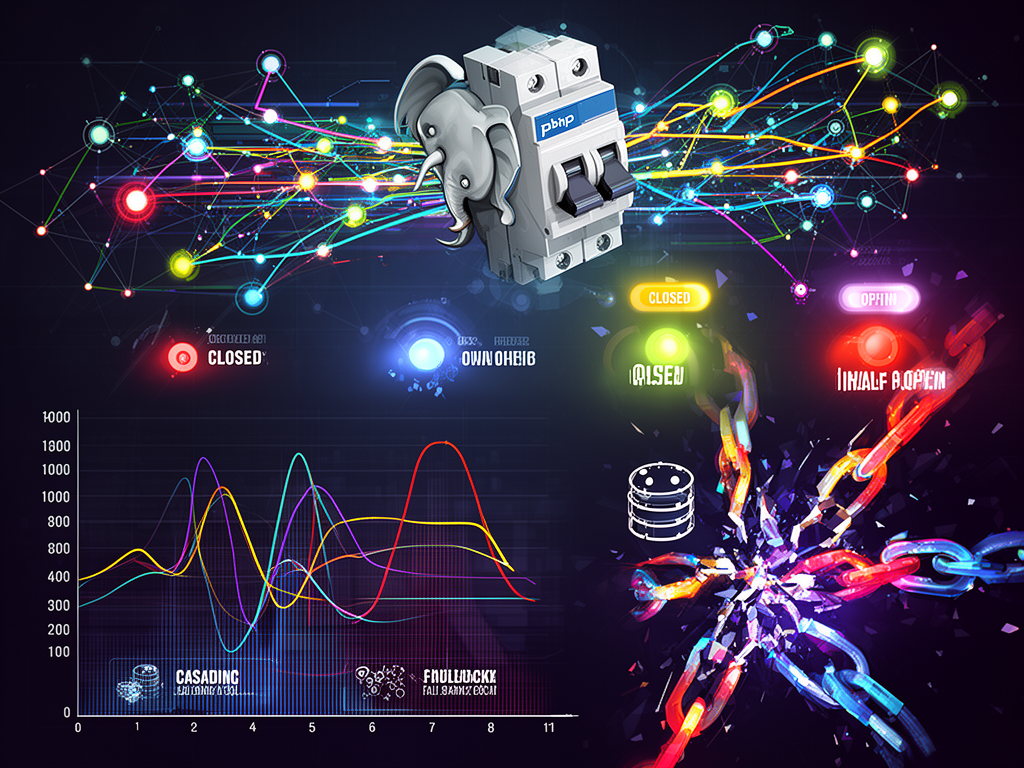
- After a cooldown period, it moves to half‑open, lets a small number of test calls through.
- If those succeed, it closes again and resumes normal traffic. If they fail, it opens again.
It’s like an electrical breaker in your house:
- Closed: electricity flows.
- Open: something is wrong, power cut.
- Half‑open: checking if it’s safe to restore power.
That’s the idea, but in PHP land, we have actual tools and libraries — not just diagrams.
Three States, One Nervous Developer
I like thinking about circuit breakers through a very human lens.
You’re calling a third‑party API from your Laravel app — say a payment gateway, a shipping API, or a geolocation service. Imagine the flow as a conversation:
-
Closed state:
“Cool, service looks healthy. Let’s send all requests there like normal.” -
Open state:
“Look, we’ve had 20 timeouts in the last minute. This API is on fire. I’m not sending more requests just to get yelled at. Let’s stop and immediately return an error or a fallback.” -
Half‑open state:
“Okay, we’ve waited 60 seconds. Let’s try a couple of careful test calls. If they work, great, back to normal. If not, we keep blocking.”
With every request, the breaker is asking:
- How many failures have I seen recently?
- Is this dependency healthy?
- Should I let this request reach it, or fail fast with a fallback?
The result for your users is deceptively simple: the app feels more stable. They get quick responses, even when something external is broken.
Why PHP APIs Need Circuit Breakers More Than We Admit
PHP has a strange reputation: “stateless,” “just handle the request,” “scripts that start and end quickly.” But look at modern PHP systems on platforms like Find PHP:
- Long‑running queues and workers.
- Microservices behind Nginx, talking over HTTP or AMQP.
- Heavy use of HTTP clients like Guzzle.
- Redis, RabbitMQ, external APIs for email, payment, search, ML.
The more external calls you make, the more you depend on:
- Networks not flaking.
- Third‑party APIs staying fast and available.
- Databases not throttling.
Circuit breakers help when:
- A dependency is rate‑limited or throttling.
- A remote API starts timing out unpredictably.
- A migration or maintenance window makes a service partially offline.
- Your worker farm amplifies every failing call into a storm of retries.
Instead of letting your PHP app be a polite victim, circuit breakers turn it into a respectful neighbour: “You’re under stress, I’ll stop pestering you. I’ll serve what I can from my side and come back later.”
PHP Circuit Breaker Libraries Worth Knowing
You don’t have to implement this from scratch at 3 AM.
There are several mature, production‑ready implementations in PHP:
-
Ganesha
A well‑known, actively maintained circuit breaker library for PHP, supporting multiple strategies (failure rate, slow calls, etc.) and storages like Redis or APCu. It integrates nicely with Guzzle as middleware and has been used in real systems. -
Circuit Breaker PHP (Leonardo Carmo)
A package that uses Redis as a backend and provides adapters, middleware, and simple static APIs to track success/failure and decide availability. It’s simple to get started with and fits Laravel ecosystems quite well. -
Other GitHub libraries like php-circuit-breaker or php-circuit-breaker for microservices
These are often more focused minimal implementations — good for learning or smaller projects, especially when you want control over storage (APC, Memcached, Redis).
The point isn’t to pick a “perfect” library. The point is: in PHP in 2026, the circuit breaker pattern is not exotic. It’s available, documented, and tested. You can use it in:
- Laravel
- Symfony
- Slim
- Custom frameworks
- Legacy monoliths with Guzzle sprinkled everywhere
And you should, when the stakes are high.
A Concrete Scenario: PHP + API + Bad Monday
Imagine this: you maintain a PHP API that aggregates data from three services:
- Currency conversion API
- Shipping cost API
- Tax calculation API
Your endpoint /quote does something like:
- Fetch exchange rate.
- Fetch shipping cost.
- Fetch tax rate.
- Return final price.
All three are external services.
One morning, the shipping API slows down. Timeouts go from 200ms to 10 seconds. Your /quote endpoint now hangs for seconds, sometimes timing out entirely.
Users start refreshing, spamming more requests, making things worse.
With a circuit breaker protecting that shipping API:
- After a few failed or slow calls in a short window, the breaker opens.
- Further
/quotecalls immediately use a fallback for shipping:- Maybe a cached last‑known rate.
- Maybe a “shipping temporarily unavailable” flag and a warning.
- The breaker waits a configured period.
- Later, it lets a few test calls through (half‑open).
- If those succeed, it closes and resumes normal behaviour.
Your users get:
- Immediate responses.
- Honest messages: “Live shipping estimate unavailable, using cached rate” or “We’ll confirm shipping later.”
Your system gets:
- No storm of slow connections.
- A graceful way to survive a bad Monday.
You avoid the dreaded “we had to restart all workers and increase timeouts” story.
Little PHP, Big Impact: Sketching The Flow
Let’s sketch the mental model using an abstract circuit breaker library. The details change per package, but the flow is similar.
You’d usually do something like:
-
Configure the breaker:
- Failure threshold (e.g., 5 errors in 60 seconds)
- Time window
- Cooldown time before half‑open
- Storage (Redis, APCu, etc.)
-
Wrap external calls:
- Check if the circuit is available.
- If open: immediately run fallback or throw exception.
- Execute the API call.
- Record success or failure.
That structure lets you plug circuit breakers into:
- HTTP client factories
- Repository or service classes
- Specific API clients (billing, search, etc.)
The important part is not the exact code; it’s that you start thinking:
“Whenever I call something that lives outside my process, I want to have a story for when it misbehaves.”
Where To Put The Circuit Breaker In A PHP App
There’s always the architectural question:
“Should I wrap my controllers? My repositories? My HTTP client?”
For API‑heavy PHP apps, I’ve found a few patterns that feel pragmatic:
-
Around your HTTP client
You build a dedicated client for each external service:PaymentGatewayClient,ShippingClient,SmsProviderClient.
Each one has a circuit breaker inside. The rest of your app just calls methods likesendPayment()orcalculateShipping(). -
At the integration layer
If you use service classes, you can put your circuit breaker logic there, shielding controllers from knowing about “open vs closed” states. Controllers get either a result or an exception they can translate into an API response. -
Middleware for specific outbound calls
Some libraries (like Ganesha) integrate as Guzzle middleware. This is nice when you already centralize your HTTP clients and want circuit break set‑up to be mostly configuration.
The key is conceptual:
- Circuit breakers belong where the boundary with the external world is, not all over your code.
- You don’t wrap internal repository calls with circuit breakers; you wrap calls to:
- External APIs
- Message queues
- Services you don’t own
Think of it this way:
“Anywhere an outage can cascade, that’s a good candidate for a circuit breaker.”
Fallbacks: Your API’s Plan B
Circuit breakers without fallback logic are just faster failures.
Sometimes that’s fine: returning a quick 503 can already be better than hanging for 30 seconds. But the real power shows when you add fallbacks that feel respectful to your users.
Depending on context, your fallback can be:
- A cached result from the last successful call.
- A degraded version of functionality:
- “Search is read‑only.”
- “Shipping estimate is approximate.”
- A queued request:
- “We’ll process this later and notify you.”
- A clear error:
- “Live payment provider is unavailable, please try again in a few minutes.”
In PHP, that might mean:
- Returning a precomputed response from Redis.
- Serving data from your own database instead of a remote API.
- Logging the failed intent and running a worker later to replay it.
The beauty is: circuit breakers give you the hook for this logic.
You know when you’ve stopped calling the remote service. You know when you’re trying again. You can tie this to UI messaging, API error formats, and monitoring.
Your API becomes more like a human:
“I can’t reach that service right now. Here’s the best I can do, and I’ll try again later.”
Best Practices That Save You Pain
If you’re thinking about wiring circuit breakers into your PHP API integrations, a few battle‑tested ideas help a lot.
-
Set realistic thresholds
Don’t trip the breaker on two random timeouts. Use your traffic patterns:- How often do you call the service?
- How often does it normally fail?
Set thresholds that catch real incidents, not noise.
-
Combine with timeouts and retries
Circuit breakers don’t replace proper:- Timeouts on HTTP calls.
- Retry policies with backoff.
They complement them. Timeouts detect slowness; retries give services a second chance; circuit breakers stop everything when the situation is clearly bad.
-
Monitor and log everything
Track:- When the circuit opens.
- When it moves to half‑open.
- When it closes again.
These transitions are gold for incident analysis. And frankly, for your future self, staring at Grafana at midnight.
-
Gradual recovery
Don’t go from “zero traffic” to “full blast” instantly. Half‑open state might:- Allow a limited number of requests.
- Slowly ramp up.
It’s like giving the recovering service a glass of water instead of a fire hose.
-
Don’t sprinkle circuit breakers everywhere
Use them where:- You don’t control the dependency.
- Failures can cascade.
- You have a meaningful fallback or can at least fail fast.
Not every HTTP call needs a circuit breaker. Start where the risk is real.
Circuit Breakers And PHP Careers
Since you’re reading this on a platform like Find PHP, let’s be honest about another dimension: careers.
Being the developer who introduces circuit breakers into a fragile system is one of those quiet career accelerators:
- You’re not just “writing endpoints.”
- You’re thinking about operational resilience.
- You’re bridging the gap between development and reliability.
When hiring PHP specialists, teams are increasingly asking:
- “Have you built resilient integrations?”
- “How do you protect your system from flaky dependencies?”
- “What’s your strategy around timeouts, retries, and fallbacks?”
Circuit breaker experience — even on a modest scale — tells a story:
“I’ve seen services fail. I don’t pretend they’re perfect. I design my code with that in mind.”
That matters whether you’re:
- Looking for PHP jobs focused on APIs and microservices.
- Hiring developers who can keep systems stable under stress.
- Building products where external integrations are unavoidable.
Resilience is a skill. Circuit breakers are one way you demonstrate it.
The Human Side Of Reliability
Behind every “CircuitBreaker::failure('my-service')” there’s a real moment:
- A user waiting, cursor spinning.
- A developer checking logs, narrowing eyes.
- An ops person watching latency graphs climb.
Patterns like circuit breakers aren’t just about elegant diagrams. They’re about protecting people from the worst versions of their day:
- The frantic outage.
- The long debugging call.
- The awkward “we’re down again” message.
In PHP, we sometimes underestimate how much our apps matter. They serve ecommerce, payroll, healthcare, logistics. They shape someone’s morning without them ever knowing your name.
When you add a circuit breaker around that fragile integration, you’re quietly saying:
“I know things break. But when they do, I’ll make sure we fail with grace, not chaos.”
And in the glow of that late‑night monitor, with logs rolling by and coffee going cold, that small act of thoughtfulness can feel like the difference between barely coping and quietly building something you trust.
That feeling — of code that stands steady when the world around it shakes — is the one that stays with you long after the bug is fixed and the incident is closed.
Building Trust One Request At A Time
If you strip away the buzzwords, circuit breaker patterns for PHP API integrations are really about one thing: trust.
- Can your team trust the system to behave predictably when an external API struggles?
- Can your users trust your application to respond, even when some features degrade?
- Can you trust your own code not to amplify a bad situation into a full‑scale outage?
You start with simple pieces:
- A library to track failures.
- A few failure thresholds.
- A fallback that doesn’t pretend everything is fine, but doesn’t abandon the user either.
Then you watch what happens in production:
- You see circuits open during provider outages instead of graphs going vertical.
- You see error responses become consistent instead of chaotic.
- You see deploy days feel less like gambling and more like engineering.
From there, circuit breakers stop being “some pattern I read about” and become part of how you think in PHP:
- “New payment provider? Cool. What’s our circuit breaker strategy?”
- “New microservice? Okay. How do we protect it from downstream failures?”
- “New job queue? Right. How does it behave when RabbitMQ is not okay?”
The more you work this way, the less shocking outages feel. Not because they stop happening — they won’t — but because your system is already designed to absorb them.
As developers, we spend a lot of time chasing features, frameworks, and versions. Circuit breakers remind us of a quieter craft: making things that can be relied on, even when their world doesn’t cooperate.
If you can do that in PHP — in the real, imperfect, production world — you’ve already moved beyond just writing code. You’re building systems that stand alongside people, in all the messy, unpredictable reality they live in.
And there’s something quietly motivating about knowing that the next time an API goes dark at 4 AM, your code will take a deep breath, open or close a circuit, and keep going in the most humane way it knows how.